Imagine a world without cities, roads, kings, temples, writing, or even agriculture.
No Istanbul. No Rome. No Egypt. No pyramids. No empires.
For more than 95 percent of human history, people lived as hunter-gatherers. Small groups moved across landscapes following animal migrations, seasonal plants, rivers, and changing weather. They carried few possessions, built temporary shelters, and survived through an intimate knowledge of nature.
For hundreds of thousands of years, this way of life changed very little.
Then something extraordinary happened.
Around 12,000 years ago, at the end of the last Ice Age, humanity began one of the greatest transformations in its history. People started settling in permanent communities. They built houses instead of temporary camps. They cultivated plants instead of only gathering them. They domesticated animals rather than simply hunting them. Communities became larger, social structures became more complex, and the foundations of civilization slowly emerged.
Archaeologists call this period the Neolithic Age, or the New Stone Age.
For much of the twentieth century, scholars believed they understood how this transformation occurred. The story seemed straightforward: first agriculture developed, then villages appeared, and eventually people built temples, monuments, and complex societies.
But discoveries of Neolithic Sites of Turkey changed that narrative forever.
Across Anatolia, archaeologists uncovered sites that pushed the boundaries of what we thought early humans were capable of achieving. Massive stone monuments older than Stonehenge. Organized settlements thousands of years before the first cities. Sophisticated symbolic art created by people who had not yet developed writing. Ritual centers built by communities that were still transitioning from hunting and gathering to settled life.
The discoveries at Gobeklitepe shocked the archaeological world. Suddenly, long-held assumptions about the origins of civilization had to be reconsidered.
Perhaps people did not first settle because of agriculture.
Perhaps shared beliefs, rituals, gatherings, and social cooperation were equally important forces in bringing people together.
Today, Turkey contains some of the most important Neolithic sites on Earth. Together, they tell the story of how humanity changed from mobile hunter-gatherers into settled communities that would eventually give rise to cities, kingdoms, religions, and civilizations.
If Ancient Egypt represents the age of great monuments and Mesopotamia represents the age of the first cities, Anatolia represents something even more fundamental:
the moment humanity began taking its first steps toward civilization.
Among these discoveries, sites such as Gobeklitepe and Karahantepe have fundamentally changed our understanding of the Neolithic world and the origins of civilization.
Understanding the Neolithic Age
Human history is divided into several major prehistoric periods.
Paleolithic Age (Old Stone Age)
The Paleolithic period lasted for hundreds of thousands of years and represents the vast majority of human history.
During this era, people lived as hunter-gatherers. They used stone tools, hunted wild animals, collected edible plants, and moved frequently in search of resources. Communities were generally small, mobile, and deeply connected to their natural surroundings.
Famous cave paintings in Europe, stone tools found across Africa and Asia, and the earliest evidence of symbolic behavior all belong to this period.
Epipaleolithic Period
As the Ice Age came to an end, human communities began adapting to changing environments.
Some groups became less mobile and started returning repeatedly to the same locations. Seasonal camps gradually became more permanent. This transitional period laid the foundation for the revolutionary changes that would follow.
Neolithic Age (New Stone Age)
The Neolithic period marks one of the most important turning points in human history.
People began building permanent settlements.
Agriculture emerged.
Animals were domesticated.
Communities became larger and more organized.
Architecture became increasingly sophisticated.
Religious and symbolic practices developed in new forms.
For the first time, humans began fundamentally reshaping their environment rather than simply adapting to it.
The Neolithic was not merely a technological revolution.
It was a social revolution.
It was a cultural revolution.
It was the beginning of the world we live in today.
Why Turkey Is So Important
Few countries possess such an extraordinary concentration of Neolithic sites as Turkey.
Stretching from southeastern Anatolia to the plains of Central Anatolia, these sites document different stages of humanity’s transition into settled life.
Some reveal the world’s earliest monumental architecture.
Others preserve evidence of the first farming communities.
Some demonstrate the rise of social organization and ritual behavior.
Together, they form one of the most complete archaeological records of the Neolithic world anywhere on Earth.
Among these sites, none is more famous than Gobeklitepe.
1. Gobeklitepe: The Site That Rewrote Human History
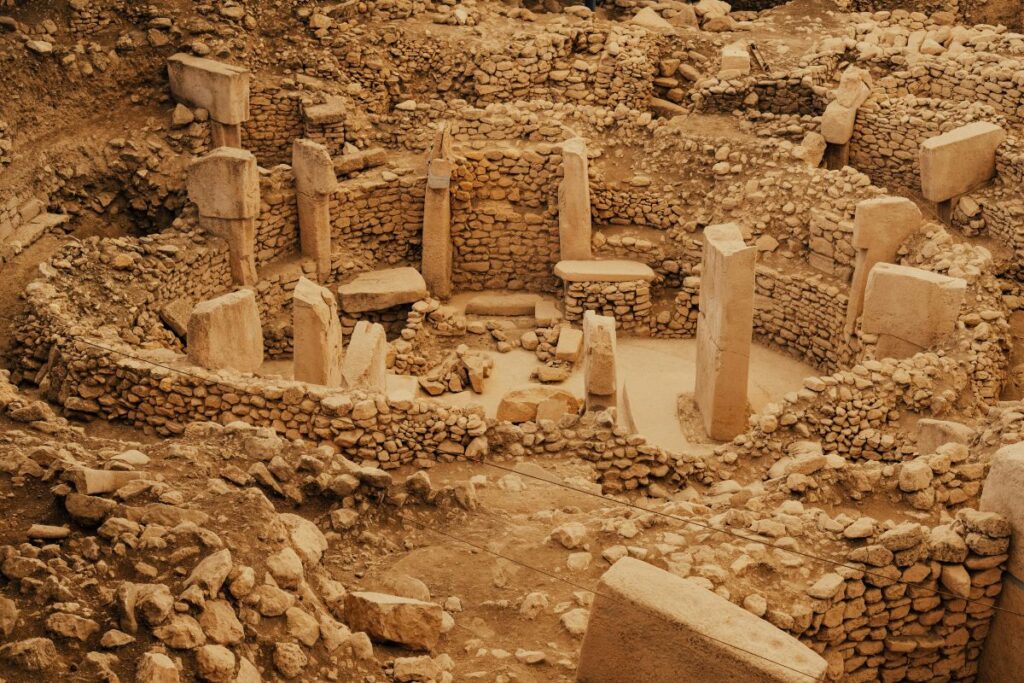
Few archaeological discoveries have transformed our understanding of the past as dramatically as Gobeklitepe.
Located on a limestone ridge approximately 15 kilometers northeast of Sanliurfa, Gobeklitepe remained hidden beneath an artificial mound for thousands of years. Local farmers had long noticed unusual stones emerging from the ground, but few imagined they were looking at one of the most important archaeological sites ever discovered.
In 1994, German archaeologist Klaus Schmidt visited the site while surveying prehistoric settlements in southeastern Turkey. What he saw immediately caught his attention. Unlike ordinary stones scattered across a hill, these appeared intentionally shaped and deliberately placed.
Schmidt later described realizing almost instantly that the hill concealed something extraordinary.
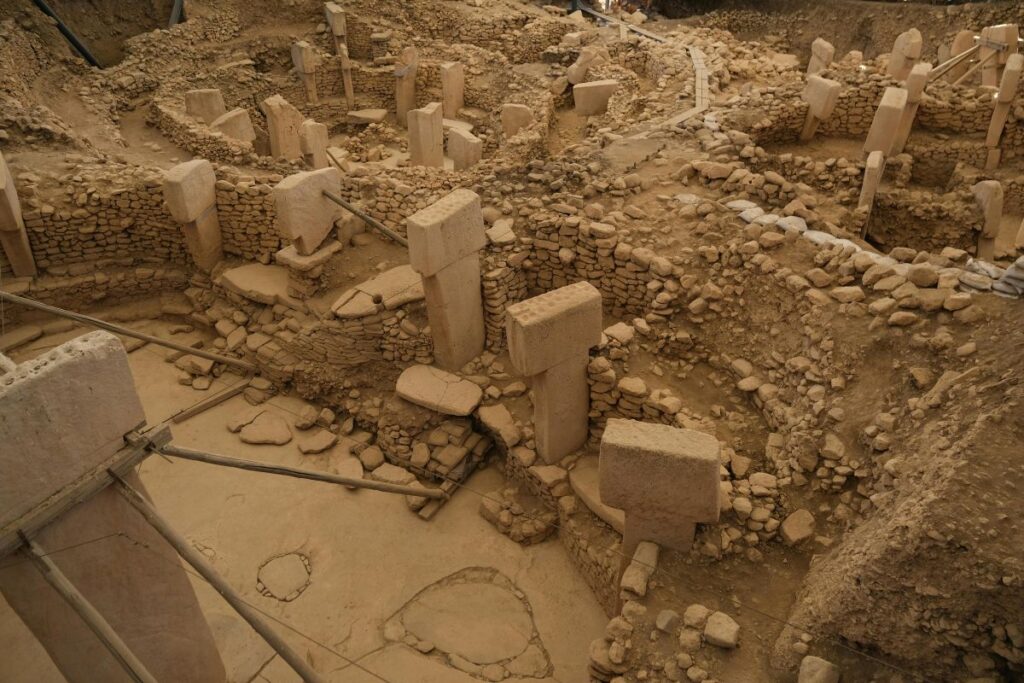
Excavations soon revealed massive T-shaped limestone pillars arranged in circular enclosures. Some pillars weighed several tons and were decorated with remarkable relief carvings of foxes, snakes, wild boars, vultures, cranes, gazelles, and other animals that inhabited the region more than 11,000 years ago.
The age of the site shocked archaeologists.
Radiocarbon dating suggested that parts of Gobeklitepe were constructed around 9600 BC, making them thousands of years older than Stonehenge and far older than the Egyptian pyramids.
What made this discovery even more revolutionary was the apparent absence of a fully developed agricultural society.
For decades, archaeologists generally believed that agriculture came first. Farming produced food surpluses. Food surpluses supported larger populations. Larger populations eventually created monuments, temples, and complex social structures.
Gobeklitepe challenged this sequence.
The people who built these enormous stone structures were likely still heavily dependent on hunting and gathering. Yet they were capable of organizing labor, transporting multi-ton pillars, carving intricate reliefs, and constructing monumental ritual spaces.
Suddenly, researchers were forced to reconsider one of the most fundamental questions in archaeology.
Did agriculture create complex societies?
Or did cooperation, ritual gatherings, and shared beliefs encourage people to settle together, eventually leading to agriculture?
While scholars continue debating the answer, Gobeklitepe fundamentally changed the discussion.
The symbolism found throughout the site adds another layer of mystery. Animal carvings dominate the enclosures, but their exact meaning remains unknown. Some researchers interpret them as spiritual symbols. Others see them as representations of myths, clan identities, or protective figures.
The T-shaped pillars themselves may represent stylized human beings. Several feature carved arms, hands, belts, and loincloths, suggesting that these stones were more than architectural supports. They may have represented ancestors, spirits, or powerful beings important to the community.
Today, visitors can walk through a modern protective shelter overlooking the excavation area. Elevated walkways provide excellent views of the monumental enclosures while preserving the fragile remains below.
Standing before these pillars is a remarkable experience.
Long before cities, writing, kings, or organized states existed, people gathered here for purposes we still do not fully understand.
That mystery is precisely what makes Gobeklitepe so fascinating.
More than any other site in Turkey, it reminds us how much of humanity’s earliest story remains to be discovered.
While sites like Gobekli Tepe reveal the beginnings of monumental architecture, they represent only the first chapter of Anatolia’s long history. To see how this period connects with later civilizations, explore our complete Museums in Turkey guide.
For a deeper look at the world’s oldest known monumental sanctuary, read our complete guide to Gobeklitepe and 22 Unesco World Heritage Sites of Turkey.
2. Karahantepe – Gobeklitepe’s Mysterious Neighbor
For many years, Gobeklitepe seemed almost unique.
Its monumental pillars, sophisticated carvings, and astonishing age appeared so extraordinary that some researchers wondered whether it represented a singular phenomenon in human history. However, ongoing discoveries across southeastern Turkey have revealed a much larger story.
Among these discoveries, none may prove more important than Karahantepe.
Located roughly 35 kilometers east of Sanliurfa, Karahantepe forms part of the Tas Tepeler project, a network of prehistoric sites dating to the Pre-Pottery Neolithic period. While Gobeklitepe introduced the world to the possibility of complex ritual architecture before fully developed farming societies, Karahantepe demonstrates that such communities were not isolated.
They belonged to a broader cultural landscape stretching across Upper Mesopotamia and southeastern Anatolia.
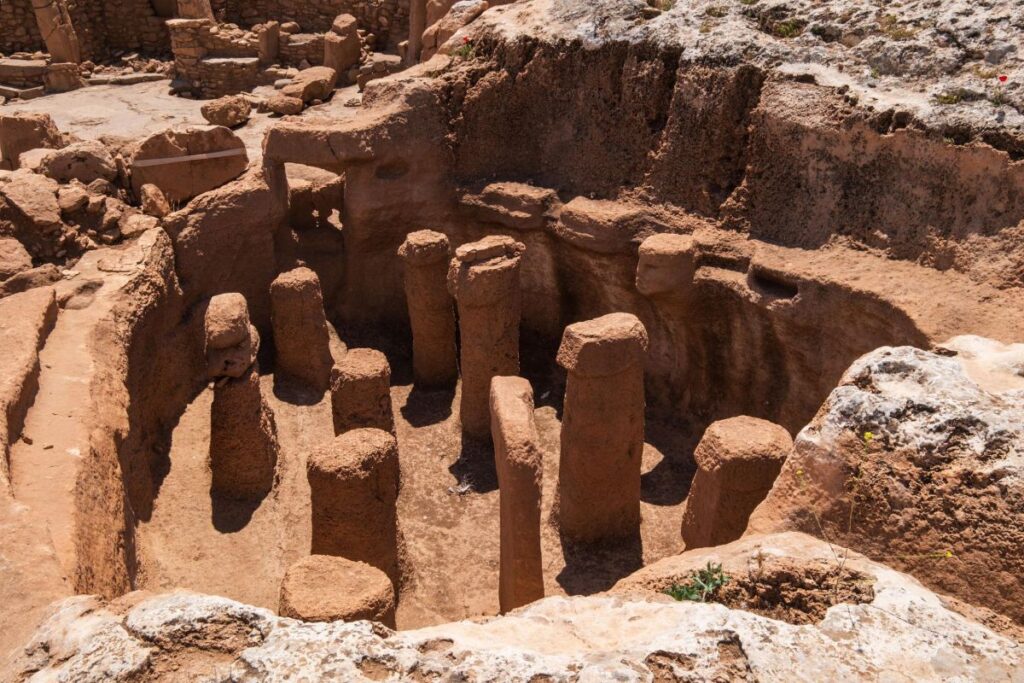
Excavations at Karahantepe have uncovered hundreds of T-shaped stone pillars, monumental structures, human sculptures, animal representations, and ritual spaces carved directly into the bedrock.
One of the most remarkable discoveries is a large semi-subterranean structure containing stone benches and human representations. At its center stands a striking human figure emerging from the rock itself. The sculpture’s intense facial expression and commanding presence create one of the most powerful images yet discovered from the Neolithic world.
Unlike later civilizations that left written records explaining their beliefs, the people of Karahantepe left only stone.
As a result, archaeologists must reconstruct their worldview through architecture, symbolism, and material remains.
This mystery makes the site particularly fascinating.
Why were these structures built?
What ceremonies took place here?
Who gathered within these spaces?
Were they temples, meeting halls, initiation chambers, or something entirely different?
At present, no one can answer these questions with certainty.
What researchers do know is that the builders possessed remarkable technical skills. They shaped limestone blocks with stone tools, carved intricate figures, and organized labor on a scale previously thought impossible for communities of this period.
Karahantepe also challenges the traditional image of prehistoric people as small, scattered groups struggling simply to survive.
The site suggests the existence of organized communities capable of long-term planning, collective projects, and sophisticated symbolic expression.
Perhaps most importantly, Karahantepe confirms that Göbeklitepe was not an isolated miracle.
Instead, both sites appear to represent part of a broader cultural tradition that flourished across southeastern Anatolia more than 11,000 years ago.
This realization may ultimately prove just as important as the discovery of Göbeklitepe itself.
Rather than a single extraordinary site, archaeologists are now uncovering an entire prehistoric world.
And Karahantepe is rapidly becoming one of its most important chapters.
Together with Gobeklitepe, Karahantepe forms part of the remarkable Taş Tepeler landscape that is reshaping our understanding of prehistoric Anatolia.
Why It Matters
Karahantepe demonstrates that the monumental architecture and symbolic traditions seen at Gobeklitepe were part of a wider Neolithic cultural network. It is helping archaeologists reconstruct an entire prehistoric landscape that may fundamentally reshape our understanding of the origins of civilization.
3. Nevali Cori: The Lost Neolithic Settlement Beneath the Waters
Today, you cannot visit Nevali Cori.
There are no ancient walls to walk between, no protective shelters covering excavation trenches, and no archaeological pathways leading visitors through its ruins.
Instead, the site lies beneath the waters of the Ataturk Dam in southeastern Turkey.
Yet despite being lost beneath a vast artificial lake, Nevali Cori remains one of the most important Neolithic settlements ever discovered.
In many ways, it helped prepare archaeologists for the revolutionary discoveries that would later emerge at Gobeklitepe.
Located near the Euphrates River in Sanliurfa Province, Nevali Cori was occupied during the Pre-Pottery Neolithic period, approximately between 8500 and 7900 BC. The settlement was first excavated during rescue operations in the 1980s, before the construction of the Ataturk Dam permanently flooded the area.
Archaeologists knew they had limited time.
As the waters of the future reservoir slowly approached, excavation teams worked urgently to document and recover as much information as possible before the site disappeared forever.
What they uncovered would prove extraordinary.
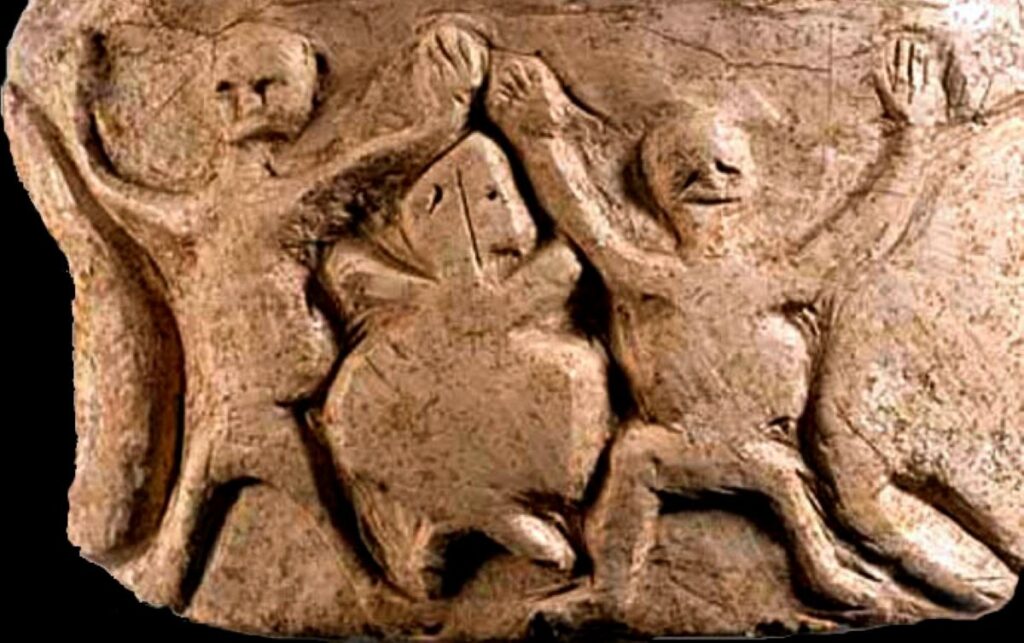
Unlike many early Neolithic settlements, Nevali Cori contained both domestic structures and a remarkable communal building that appeared to serve ritual or ceremonial purposes. Inside this structure stood limestone pillars strikingly similar to those later made famous by Gobeklitepe.
These T-shaped pillars immediately attracted attention.
At the time, they seemed unusual and difficult to explain. Only years later, after excavations at Gobeklitepe revealed dozens of similar pillars on a monumental scale, did archaeologists fully appreciate the significance of what had been discovered at Nevali Cori.
The site also produced some of the earliest known life-sized human sculptures in Anatolia. These stone figures demonstrate a level of artistic expression and symbolic thinking far more sophisticated than many researchers once expected from communities of this age.
For decades, prehistorians tended to view early farming communities as relatively simple villages focused primarily on survival.
Nevali Cori challenged that assumption.
Its architecture, sculptures, ritual spaces, and symbolic artifacts suggested that these people possessed complex beliefs, shared traditions, and a rich spiritual world.
The settlement itself consisted of rectangular mudbrick houses arranged in an organized pattern. Archaeologists discovered evidence of farming, animal management, tool production, and everyday domestic activities. Yet alongside these practical aspects of life existed something equally important: a strong investment in symbolism, ritual, and communal identity.
This combination is what makes Nevali Cori so fascinating.
It stands at a moment when humanity was transforming itself.
People were no longer simply hunter-gatherers moving across the landscape. They were becoming villagers, farmers, builders, and members of increasingly organized communities.
At the same time, they were creating monuments, sculptures, and ceremonial spaces that reveal a surprisingly sophisticated intellectual and spiritual life.
Today, many researchers view Nevali Cori as a crucial link between earlier hunter-gatherer traditions and the more elaborate ritual landscapes represented by Gobeklitepe and Karahantepe.
Without Nevali Cori, the story of the Neolithic Revolution in Anatolia would be far more difficult to understand.
Its loss beneath the waters of the Ataturk Dam makes the site even more poignant.
Although the original settlement can no longer be visited, its discoveries continue to influence archaeological research around the world. Every new finding at Gobeklitepe, Karahantepe, or other Tas Tepeler sites is interpreted partly through the evidence first uncovered at Nevali Cori.
In that sense, Nevali Cori is not truly lost.
Its buildings may lie beneath the waters of the Euphrates, but its importance remains firmly embedded in the story of how civilization began.
Why It Matters
Nevali Cori provided some of the earliest evidence for T-shaped pillars, ritual architecture, and symbolic art in the Neolithic world. Although the site now lies beneath the Ataturk Dam reservoir, it remains a crucial link between the earliest farming communities and the monumental ritual centers that later emerged across southeastern Anatolia.
4. Catalhoyuk: A Town Without Streets
Imagine living in a settlement where there are no streets.
No front doors.
No public squares.
No roads separating one home from another.
At first, it sounds impossible.
Yet more than 9,000 years ago, thousands of people lived exactly this way at Catalhoyuk, one of the most remarkable Neolithic settlements ever discovered.
Located on the Konya Plain of central Turkey, Catalhoyuk flourished between approximately 7400 and 6200 BC. At its peak, it may have been home to several thousand people, making it one of the largest known Neolithic communities in the world.
What makes Catalhoyuk extraordinary is not the presence of monumental temples or royal palaces.
There were none.
Instead, archaeologists discovered something arguably more valuable: an exceptionally preserved picture of everyday life.
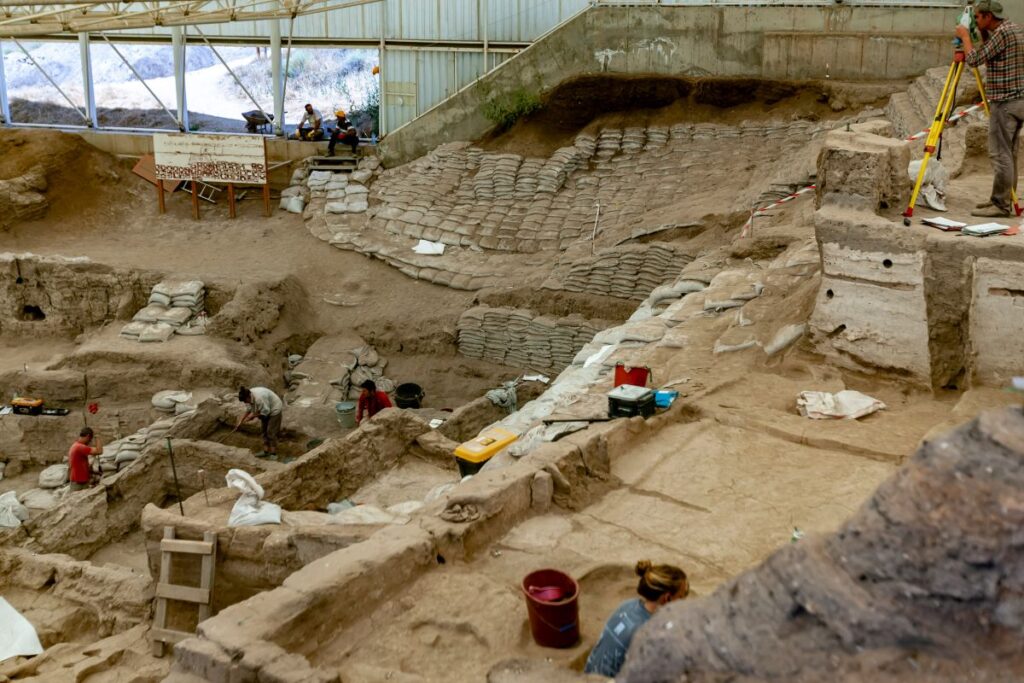
The houses of Catalhoyuk were built directly beside one another, forming a dense honeycomb of mudbrick structures. Because the buildings shared walls, there was little room for streets at ground level. Residents likely moved across rooftops and entered their homes through openings in the ceiling using ladders.
The roof was both a street and a social space.
Beneath these roofs, generations lived, worked, celebrated, mourned, and remembered.
Excavations led first by James Mellaart in the 1960s and later by Ian Hodder revealed interiors unlike anything previously known from the Neolithic world. Walls were covered with paintings. Animal horns were mounted inside homes. Sculpted installations decorated living spaces. Burials were placed beneath house floors, allowing the dead to remain physically connected to their families.
In some houses, multiple generations were buried beneath the same rooms.
For the people of Catalhoyuk, the home was not merely a shelter.
It was a place of memory.
A place of ancestry.
A place where life and death existed side by side.
Among the most famous discoveries are wall paintings that may represent hunting scenes, symbolic imagery, and perhaps even one of the earliest known landscape representations in human history. Figurines, including the famous seated female figure often associated with fertility, have generated decades of debate among archaeologists.
Yet modern research has moved away from simplistic interpretations.
Rather than seeing Catalhoyuk as a society dominated by a single fertility cult, archaeologists increasingly view it as a complex community with diverse beliefs, rituals, and social practices.
The settlement also offers valuable evidence for the transition to farming. Residents cultivated crops, managed domesticated animals, and maintained long-term occupation over centuries. At the same time, hunting remained important, demonstrating that the Neolithic transformation was gradual rather than sudden.
Perhaps the most fascinating aspect of Catalhoyuk is how familiar it feels despite its age.
The people who lived here cared for their children, decorated their homes, honored their ancestors, prepared meals, repaired buildings, and participated in community life.
Their world lacked writing, metal tools, and cities.
Yet in many ways, their concerns were surprisingly similar to our own.
Communities such as Catalhoyuk eventually laid the foundations for many of the civilizations that would later flourish across Anatolia, including the powerful Hittite Civilization.
Many of the artifacts discovered at Catalhoyuk are displayed in museums across Turkey, where they help place this remarkable settlement within the broader story of Anatolian civilization. Learn more in our Museums in Turkey guide.
Why It Matters
Catalhoyuk provides one of the most complete windows into daily life during the Neolithic Age. Unlike Gobeklitepe, which emphasizes ritual and monumental architecture, Catalhoyuk reveals how ordinary people lived, worked, raised families, and built communities thousands of years before the rise of the first cities.
5. Asikli Hoyuk: The Forgotten Beginning of Cappadocia’s Story
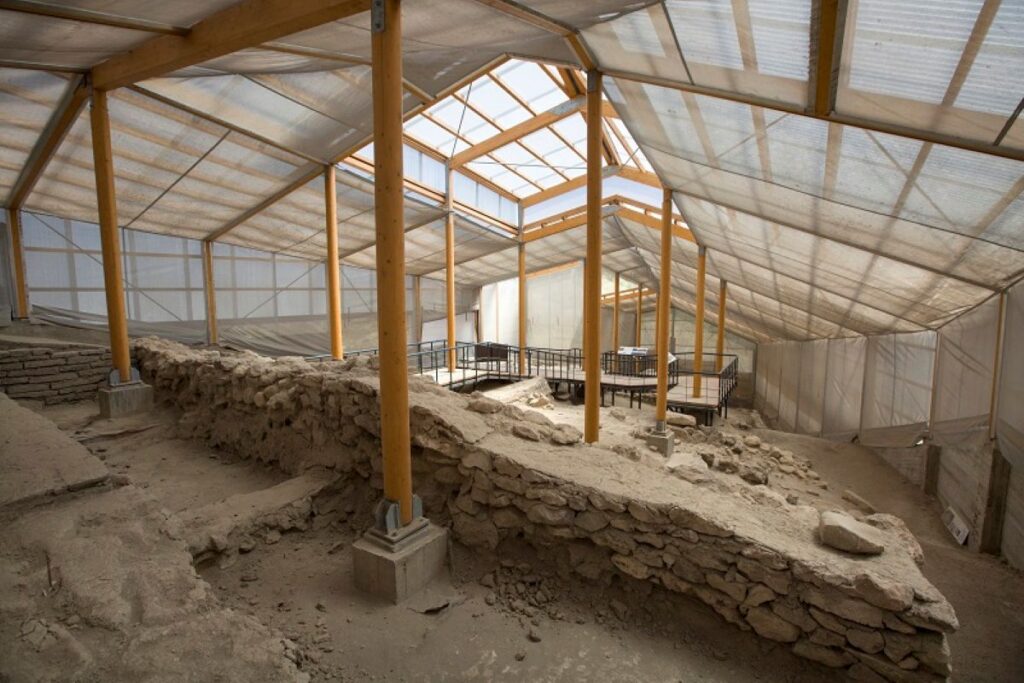
When most travelers think of Cappadocia, they imagine fairy chimneys, rock-cut churches, underground cities, and hundreds of colorful hot-air balloons floating above the valleys at sunrise.
Few realize that the human story of Cappadocia stretches back thousands of years before any of these landmarks existed.
Long before the first underground cities were carved into volcanic rock and long before Christianity reached central Anatolia, one of the region’s earliest settled communities was already thriving along the banks of the Melendiz River.
That community was Asikli Hoyuk.
Located near modern-day Aksaray, approximately an hour from the heart of Cappadocia, Asikli Hoyuk dates to around 8,400–7,400 BC. It represents one of the oldest known settlements in Central Anatolia and offers a remarkable glimpse into a world that was just beginning to experiment with permanent village life.
The people who lived here stood at a turning point in human history.
For countless generations, their ancestors had survived as hunter-gatherers, moving across landscapes in search of food and seasonal resources. At Asikli Hoyuk, however, people began building permanent homes, organizing communal spaces, and developing a lifestyle tied to a specific place.
Archaeological excavations have revealed clusters of mudbrick houses built closely together. Over centuries, these structures were repaired, rebuilt, and expanded, creating a long record of continuous occupation.
The settlement also occupied a strategically important position near some of Anatolia’s richest obsidian sources.
Obsidian, a naturally occurring volcanic glass, was one of the most valuable materials of the Neolithic world. Its razor-sharp edges made it ideal for tools, hunting equipment, and cutting instruments. Archaeological evidence suggests that obsidian from Central Anatolia traveled hundreds of kilometers through prehistoric trade networks, connecting communities across the Near East.
This means that Asikli Hoyuk was not an isolated village hidden in the Anatolian interior.
It was part of a much larger world.
The settlement also provides some of the earliest evidence for the gradual domestication of animals in Central Anatolia. Rather than a sudden agricultural revolution, the archaeological record suggests a slow and complex transition in which hunting, gathering, herding, and early farming practices existed side by side.
Perhaps the most fascinating discovery at Asikli Hoyuk concerns medicine.
Among the human remains uncovered during excavations was the skull of a young woman showing evidence of trepanation, a surgical procedure involving the deliberate opening of the skull. Remarkably, researchers believe the individual survived the operation for some time afterward because signs of healing are visible around the opening.
The discovery is extraordinary.
Imagine a community living more than 10,000 years ago, without metal instruments, hospitals, anesthesia, or written medical knowledge, attempting a complex surgical procedure on a living person.
While we may never know the exact reason for the operation, it demonstrates a surprising level of practical knowledge and care within the community.
The people of Asikli Hoyuk were not simply struggling for survival.
They were experimenting, adapting, and developing solutions to challenges in ways that continue to impress researchers today.
Excavations have also revealed burial practices that help us understand the social and spiritual lives of these early villagers. Like other Neolithic communities in Anatolia, the inhabitants of Aşıklı Höyük often buried their dead beneath house floors, maintaining a close connection between the living and their ancestors.
This practice transformed houses into places of memory as well as shelter.
For archaeologists, Asikli Hoyuk is one of the most important sites for understanding the emergence of settled life in Central Anatolia.
For visitors interested in Cappadocia’s deeper past, it offers something equally valuable: a reminder that the region’s story did not begin with fairy chimneys or underground cities.
It began thousands of years earlier, when some of Anatolia’s first villagers chose to stay in one place and build a new way of life.
Long before fairy chimneys and underground cities, the story of human settlement in Cappadocia was already unfolding, as explored in our guide to Cappadocia History.
Why It Matters
Asikli Hoyuk preserves one of the earliest chapters of settled life in Central Anatolia. Its evidence for permanent villages, obsidian trade, animal domestication, and one of the world’s earliest known examples of cranial surgery provides a remarkable window into how Neolithic communities adapted, innovated, and laid the foundations for future civilizations.
6. Boncuklu Tarla: The Field of Beads and the Hidden World of Upper Mesopotamia
Not every archaeological discovery captures global attention overnight.
Some sites emerge slowly, revealing their significance one excavation season at a time. Each new trench, each newly uncovered wall, and each carefully documented artifact adds another piece to a much larger puzzle.
Boncuklu Tarla is one of those places.
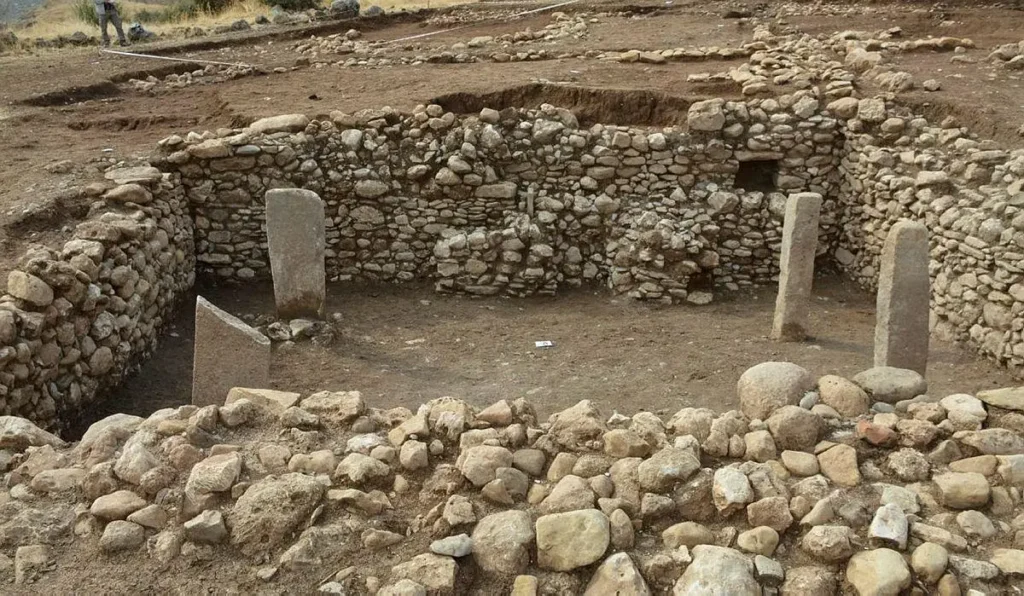
Located near the town of Dargecit in Mardin Province, in southeastern Turkey, Boncuklu Tarla has become one of the most exciting Neolithic discoveries of recent decades. Although it remains far less famous than Gobeklitepe, many archaeologists believe it may ultimately prove just as important for understanding the earliest stages of settled life in Upper Mesopotamia.
The site takes its name from the Turkish phrase “Boncuklu Tarla,” meaning “Field of Beads.” The name is a reference to the extraordinary number of beads, ornaments, and decorative objects discovered during excavations. These small artifacts may seem insignificant compared to monumental stone pillars or massive architectural remains, but they tell an equally important story.
They reveal something deeply human.
More than 11,000 years ago, the people who lived here did not focus solely on survival. They decorated themselves. They crafted ornaments. They expressed identity, status, and perhaps even personal beliefs through objects worn on the body.
In many ways, Boncuklu Tarla reminds us that the Neolithic Revolution was not simply about farming.
It was also about becoming part of a community.
Excavations began as part of rescue archaeology projects connected to the construction of the Ilisu Dam. What initially appeared to be another prehistoric settlement soon revealed itself as something much more significant.
Archaeologists uncovered remarkably preserved architecture dating to the Pre-Pottery Neolithic period, placing the site among the earliest settled communities known in the region. The discoveries demonstrated that the Upper Tigris Valley was not merely a peripheral area influenced by developments elsewhere. Instead, it was an active participant in the transformation that reshaped human history.
The people of Boncuklu Tarla lived at a time when humanity was experimenting with entirely new ways of life.
For hundreds of thousands of years, humans had survived primarily as mobile hunter-gatherers. Now communities were beginning to settle permanently, construct durable buildings, and create shared spaces that connected generations together.
The architecture discovered at Boncuklu Tarla reflects this transition.
Excavations revealed carefully constructed buildings, communal areas, and evidence of long-term occupation. Rather than temporary camps occupied for a season or two, these structures indicate a community committed to staying in one place.
This decision may seem ordinary today.
Yet in the Neolithic world, it represented one of the most important changes in human history.
Permanent settlement transformed everything.
People could store food, raise children within stable communities, accumulate knowledge, and develop increasingly complex social relationships. Villages became places where memory could be preserved across generations.
The discoveries at Boncuklu Tarla also provide fascinating insights into the symbolic lives of its inhabitants.
Thousands of beads crafted from stone, shell, and other materials have been recovered from the site. Some were likely worn as personal ornaments, while others may have played roles in ceremonies, social identity, or community traditions.
Why did these objects matter so much?
We cannot know for certain.
However, their abundance suggests that appearance, symbolism, and social expression were already important aspects of life more than eleven millennia ago.
The people of Boncuklu Tarla were not simply surviving.
They were creating culture.
Another remarkable aspect of the site is its burial practices.
Archaeologists discovered human burials beneath buildings, a practice also known from other Neolithic settlements across Anatolia and Upper Mesopotamia. This tradition suggests a close relationship between the living and the dead.
For these communities, ancestors remained part of everyday life.
Homes were not merely places of shelter. They were places of memory, identity, and continuity.
Every generation lived literally above those who had come before.
This connection between architecture, ancestry, and community appears throughout the Neolithic world and helps us understand how early societies developed strong social bonds.
Boncuklu Tarla is also important because it expands our understanding of the broader cultural landscape that existed across southeastern Turkey during the Neolithic period.
For many years, discussions about early civilization focused heavily on sites such as Göbeklitepe and, later, Karahantepe. These extraordinary discoveries transformed archaeology, but they also created the impression that a few isolated centers were responsible for major innovations.
Boncuklu Tarla tells a different story.
It demonstrates that the Neolithic transformation involved numerous interconnected communities spread across a vast region. Ideas, technologies, beliefs, and social practices were likely shared among settlements linked by networks of communication and exchange.
Civilization did not emerge in a single place.
It emerged through the interactions of many communities experimenting with new ways of living.
Today, Boncuklu Tarla continues to reveal new information with each excavation season. Archaeologists are still uncovering structures, artifacts, and evidence that help reconstruct daily life in one of humanity’s earliest settled worlds.
Although it lacks the monumental pillars of Gobeklitepe or the international fame of Catalhoyuk, its importance should not be underestimated.
Boncuklu Tarla offers something equally valuable.
It allows us to see the ordinary people behind one of history’s greatest transformations.
Their beads, houses, burials, and daily activities remind us that civilization was not built only by monumental architecture or extraordinary leaders.
It was built by communities.
By families.
By individuals whose names are lost but whose choices helped shape the future of humanity.
Located within the wider Upper Tigris region, Boncuklu Tarla highlights the importance of northern Mesopotamia during the Neolithic period.
Why It Matters
Boncuklu Tarla demonstrates that the Neolithic Revolution was not confined to a few famous sites. Its architecture, burials, and thousands of personal ornaments reveal a complex society where identity, community, and symbolism were already deeply important. Together with Gobeklitepe, Karahantepe, and other early settlements, it helps paint a richer picture of how humanity transitioned from mobile hunter-gatherers to settled communities across Upper Mesopotamia.
7. Hacilar Hoyuk: The Rise of Farming Villages in Western Anatolia
The story of the Neolithic Age is often told through dramatic discoveries such as Gobeklitepe and Karahantepe.
Massive stone pillars, mysterious rituals, and revolutionary ideas about the origins of civilization capture the imagination.
Yet civilization was not built through monuments alone.
It was built through ordinary people planting crops, raising children, storing food, constructing homes, and creating stable communities that could survive generation after generation.
To understand this stage of human history, few places are more important than Hacilar Hoyuk.
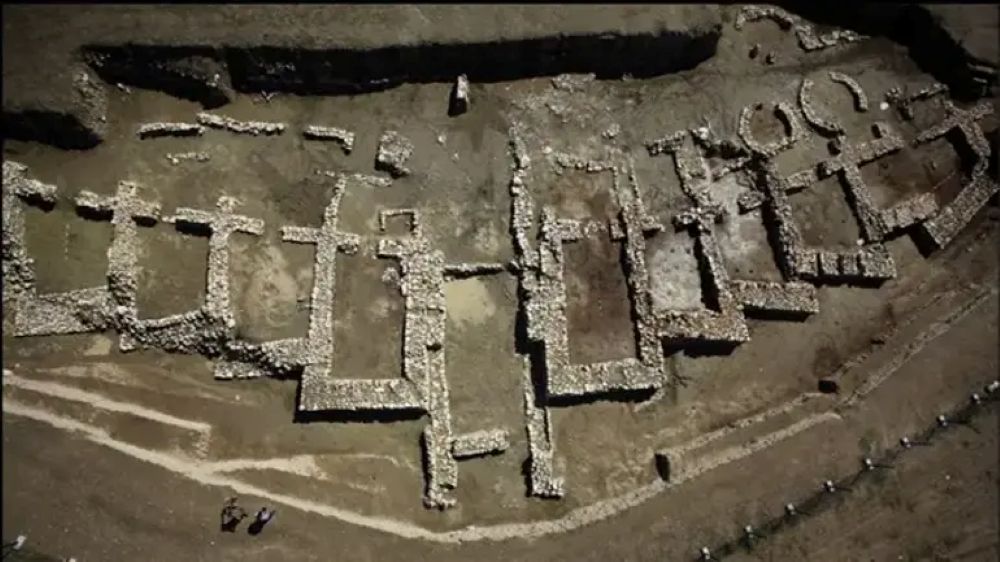
Located near modern-day Burdur in southwestern Turkey, Hacilar represents a later chapter of the Neolithic story. By the time people settled here, humanity had already taken its first steps toward farming and village life. The great experiment of permanent settlement was no longer new.
The challenge now was learning how to make it successful.
Excavations at Hacilar began in the 1950s under the direction of British archaeologist James Mellaart, who would later become famous for his work at Catalhoyuk. What he uncovered revealed a thriving farming community that flourished thousands of years before the rise of cities and states.
Unlike the earlier ritual centers of southeastern Anatolia, Hacilar offers a glimpse into a world where agriculture had become firmly established.
The inhabitants cultivated crops, raised domesticated animals, and lived in carefully planned mudbrick houses. Their daily lives revolved around food production, household activities, craftsmanship, and community relationships.
One of the most remarkable discoveries at Hacilar was its pottery.
The settlement produced beautifully crafted painted ceramics decorated with geometric patterns and distinctive designs. These vessels were not simply practical containers for storing food and water. They also reflected artistic traditions, cultural identity, and growing levels of technological skill.
The appearance of such pottery marks an important stage in human development.
For thousands of years, Neolithic communities survived without ceramics. By the time Hacilar flourished, pottery had become an essential part of daily life, allowing people to cook, store, and transport food more efficiently than ever before.
Archaeologists also discovered numerous figurines at the site, including several female representations that attracted considerable attention during the twentieth century.
Early researchers often interpreted these figures as evidence of a widespread Mother Goddess cult. While modern archaeologists approach such interpretations with greater caution, the figurines nevertheless provide valuable insights into the symbolic world of Neolithic communities.
Hacılar also demonstrates how settled life continued evolving long after the first villages appeared.
The inhabitants were not pioneers struggling to establish permanent communities for the first time. Instead, they belonged to generations that had inherited centuries of agricultural knowledge, architectural traditions, and social experience.
This is what makes the site so important.
If Gobeklitepe helps us understand how the Neolithic Revolution began, Hacilar helps us understand what happened next.
It shows how farming communities became increasingly stable, organized, and sophisticated.
The village was no longer an experiment.
It had become a way of life.
For historians and archaeologists, Hacılar represents one of the clearest examples of how Neolithic society expanded into western Anatolia. It demonstrates that the revolutionary changes first emerging in parts of southeastern and central Anatolia eventually spread across much of the region, laying foundations for future cultures that would dominate Anatolia in the millennia to come.
Today, the site may not enjoy the international fame of Gobeklitepe or Catalhoyuk, but its importance should not be underestimated.
The story of civilization is not only about the first great discoveries.
It is also about the communities that transformed those discoveries into lasting traditions.
Hacilar was one of those communities.
Why It Matters
Hacilar Hoyuk illustrates the maturation of Neolithic life in Anatolia. Its evidence for established agriculture, painted pottery, domestic architecture, and symbolic figurines shows how early farming communities evolved from experimental settlements into stable villages that would shape the future of the region.
8. Cayonu – Where Village Life and Farming Began to Take Shape
Long before the first cities rose in Mesopotamia, long before the pyramids appeared on the banks of the Nile, and thousands of years before writing transformed human history, a small community in southeastern Anatolia was experimenting with an entirely new way of life.
The people of Cayonu were among the first humans to ask a question that would ultimately change the course of history:
What if we stayed?
For hundreds of thousands of years, human survival depended on movement. Hunter-gatherer groups followed animal migrations, collected wild plants, and adapted constantly to changing seasons and environments. Mobility was not a choice—it was a necessity.
At Cayonu, however, something remarkable began to happen.
People started building permanent homes.
They remained in the same place for generations.
They cultivated plants.
They managed animals.
They created a community rooted to a specific landscape.
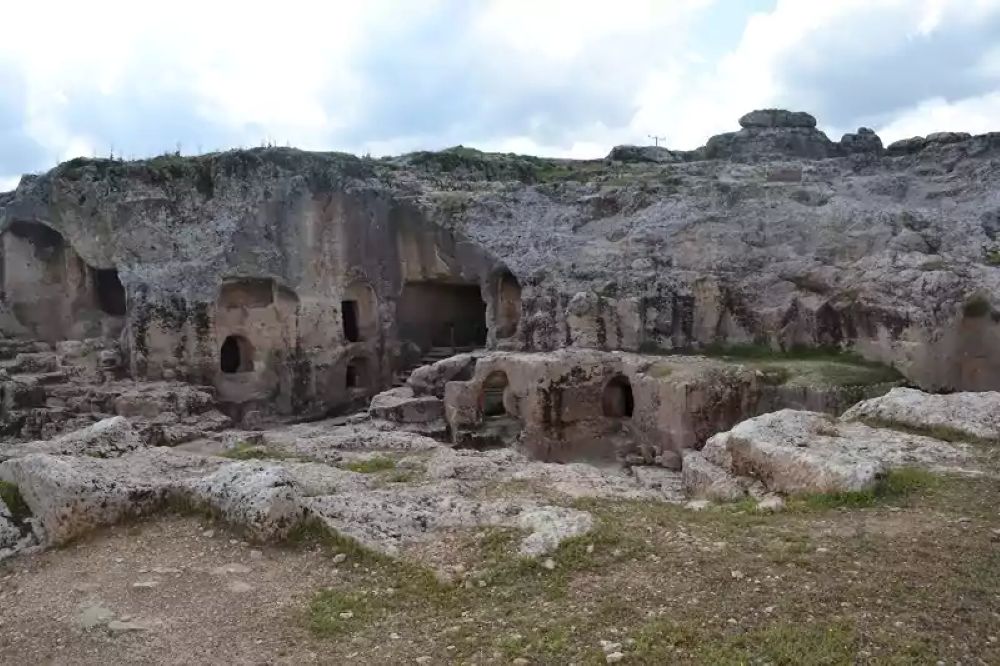
Located near modern-day Diyarbakir in southeastern Turkey, Cayonu is one of the most important Neolithic sites ever discovered. Occupied between approximately 8,800 and 6,700 BC, the settlement preserves an extraordinary record of humanity’s transition from mobile hunter-gatherers to settled villagers.
Unlike many prehistoric sites that provide only isolated snapshots of the past, Cayonu allows archaeologists to watch this transformation unfold over centuries.
Excavations have revealed multiple architectural phases, each representing a different stage in the development of village life.
The earliest inhabitants lived in relatively simple structures. Over time, houses became more sophisticated, construction techniques improved, and the settlement grew increasingly organized. Archaeologists often describe Cayonu as a living laboratory of the Neolithic Revolution because it preserves evidence for how communities adapted and evolved through time.
This is one of the reasons the site is so valuable.
Rather than showing a sudden revolution, Cayonu reveals a gradual process.
The transition to settled life was not an overnight event.
It was a long experiment that unfolded over generations.
One of the site’s greatest contributions to archaeology concerns agriculture and animal domestication.
For decades, researchers have studied plant remains, animal bones, and tools recovered from Çayönü to understand how humans moved from hunting and gathering toward food production.
The evidence suggests that the inhabitants were among the earliest communities to cultivate crops and manage animals in the region. Wild resources remained important, but people increasingly relied on domesticated plants and animals as part of their daily lives.
This shift transformed human society.
Food production made it possible to support larger populations.
Larger populations encouraged permanent settlements.
Permanent settlements led to increasingly complex social relationships.
In many ways, the foundations of civilization can be traced back to developments taking place at sites such as Cayonu.
Yet agriculture is only part of the story.
The site also provides fascinating evidence for social organization, ritual behavior, and community identity.
Among the most famous discoveries is a structure known as the Skull Building.
Unlike ordinary houses, this building appears to have served a special communal purpose. Excavations uncovered numerous human remains within the structure, suggesting that it played an important role in rituals connected to death, memory, and ancestor veneration.
Its exact function remains debated.
Some researchers believe it was used for mortuary ceremonies. Others suggest it served as a place where ancestors were honored and remembered.
Whatever its purpose, the Skull Building demonstrates that the people of Cayonu were concerned with more than food and shelter.
They were creating traditions.
They were establishing communal identities.
They were developing symbolic systems that helped bind society together.
Another remarkable discovery is evidence of early copper use.
Although true metallurgy would not emerge until much later, inhabitants of Cayonu appear to have experimented with native copper, making some of the earliest known decorative copper objects in the Near East.
This innovation provides a glimpse into the creativity and curiosity of Neolithic communities.
The people of Cayonu were not passive participants in history.
They were innovators.
They experimented with architecture, agriculture, animal management, ritual practices, and new materials.
Their choices would influence generations that followed.
Today, when visitors explore the archaeological remains of Cayonu, they are looking at one of humanity’s earliest successful village experiments.
Unlike Gobeklitepe, which is famous for its monumental ritual architecture, Cayonu tells a different story.
It reveals how ordinary people transformed daily life.
How they built homes.
How they grew food.
How they organized communities.
How they honored their dead.
And how they slowly created the foundations upon which later civilizations would be built.
Without settlements like Cayonu, there would have been no cities.
Without cities, there would have been no states, kingdoms, or empires.
The roots of all those developments can be found in places like this small village in southeastern Anatolia.
The emergence of permanent villages in southeastern Anatolia was closely connected to broader developments across ancient Mesopotamia, one of the world’s earliest cultural hearths.
Why It Matters
Cayonu provides one of the clearest records of humanity’s transition from hunting and gathering to settled village life. Its evidence for early agriculture, animal domestication, communal architecture, ancestor rituals, and even experimental copper use makes it one of the most important archaeological sites for understanding the Neolithic Revolution and the origins of civilization.
Final Thoughts
Twelve thousand years ago, the people who lived at Gobeklitepe, Karahantepe, Cayonu, and Catalhoyuk could not have imagined the world that would follow.
They knew nothing of empires, writing, mathematics, or modern nations.
Yet the decisions they made — to gather, to build, to settle, to cultivate, and to cooperate — would eventually shape every civilization that came after them.
The story of the Neolithic Age is not simply the story of ancient ruins.
It is the story of how we became who we are.