Turkey is one of the most important lands in early Christian history. Long before modern national borders existed, western and southern Anatolia formed the heart of Roman Asia Minor, a region where some of the earliest Christian communities grew, struggled, and spread their faith across the Mediterranean world.
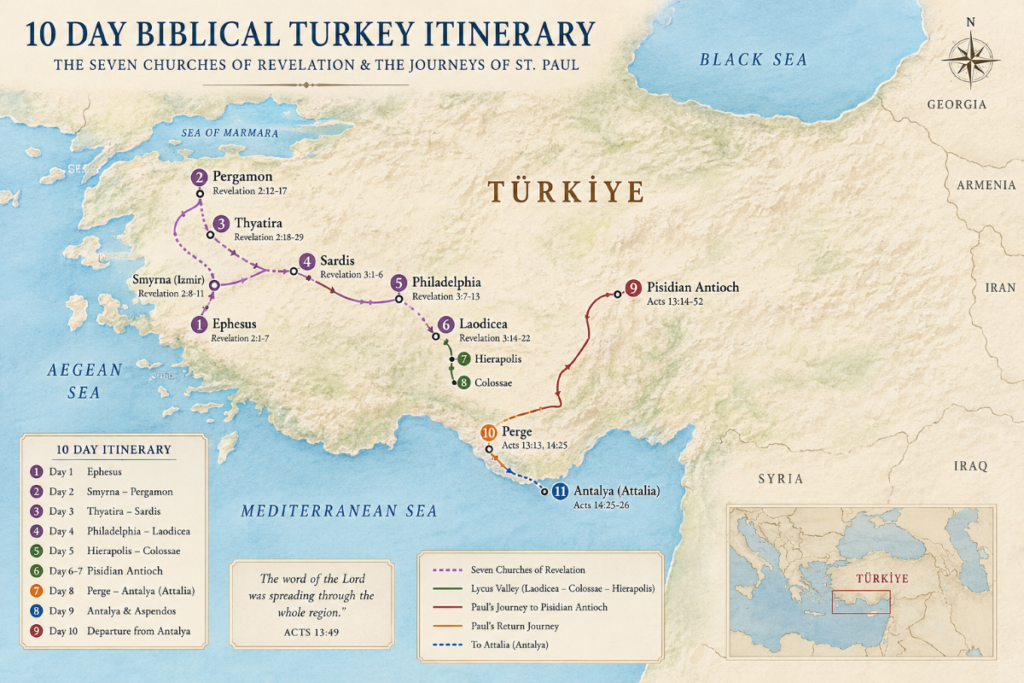
This 10 day Biblical Turkey itinerary follows two powerful themes: the Seven Churches of Revelation and the journeys of St. Paul. Along the way, you will visit Ephesus, Smyrna, Pergamon, Thyatira, Sardis, Philadelphia, Laodicea, Hierapolis, Colossae, Pisidian Antioch, and Perge.
These are not just archaeological sites. They are places mentioned in the New Testament, connected with apostles, early Christian communities, bishops, martyrs, letters, sermons, and some of the most famous passages in the Book of Revelation.
For Christian travelers, this route offers a rare opportunity to walk through the landscapes of the Bible — not as distant stories, but as real places with streets, theaters, temples, churches, synagogues, marketplaces, and ancient roads.
If you would like a broader overview of early Christian heritage in Anatolia, be sure to read our comprehensive guide to Biblical Sites in Turkey.
Why Take a Biblical Turkey Itinerary?
Many travelers associate Biblical history mainly with Israel, Jordan, Egypt, Greece, or Rome. Yet Turkey, ancient Asia Minor, played a central role in the spread of early Christianity.
The Seven Churches mentioned in Revelation were all located in western Turkey. St. Paul traveled through Anatolia during his missionary journeys. The cities of Ephesus, Colossae, Laodicea, Perge, and Pisidian Antioch are directly connected with the New Testament world.
This itinerary is ideal for travelers interested in:
- The Seven Churches of Revelation
- The missionary journeys of St. Paul
- Early Christian archaeology
- Biblical cities in Asia Minor
- Roman history and archaeology
- Christian pilgrimage in Turkey
Route Overview
Day 1: Arrival in Izmir and Ephesus
Day 2: Smyrna and Pergamon
Day 3: Thyatira and Sardis
Day 4: Philadelphia and Laodicea
Day 5: Hierapolis and Colossae
Day 6: Travel to Pisidian Antioch
Day 7: Pisidian Antioch and St. Paul’s Sermon
Day 8: Perge and Antalya
Day 9: Antalya, Aspendos or Optional Biblical Extension
Day 10: Departure from Antalya
Day 1 – Arrival in Izmir and Ephesus
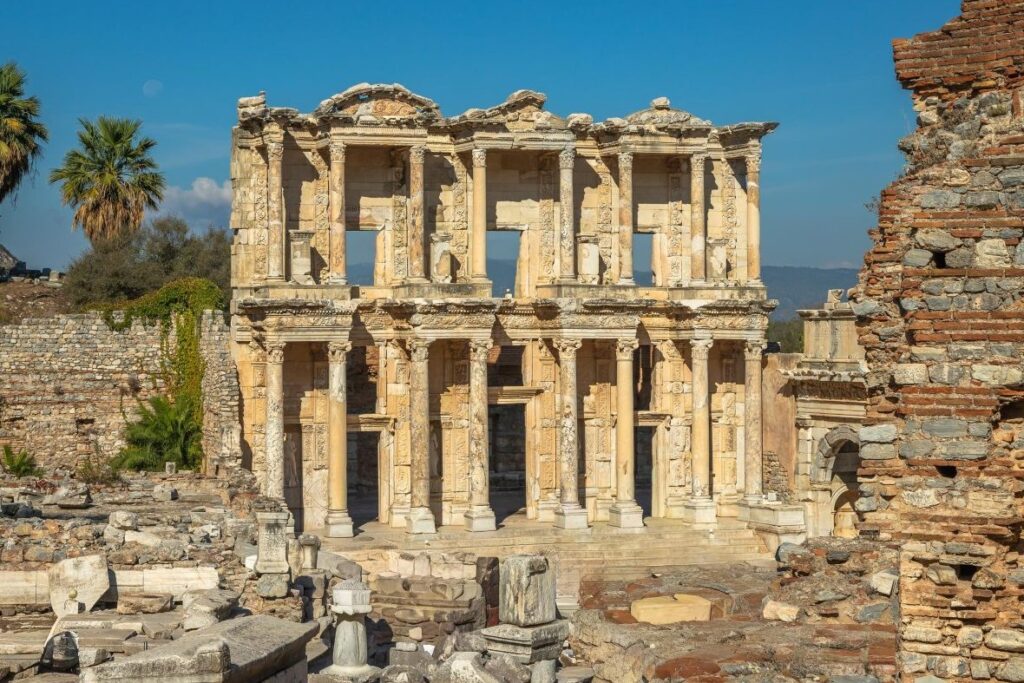
Start your Biblical journey in Izmir, one of Turkey’s major Aegean cities. After arriving at Izmir Adnan Menderes Airport, travel south to Selçuk or Kuşadası, the best bases for visiting ancient Ephesus.
Ephesus is one of the most important Biblical sites in Turkey. In the Roman period, it was one of the largest cities of Asia Minor and a major center of trade, religion, and politics. It was also one of the Seven Churches of Revelation and one of the most important cities in the ministry of St. Paul.
Paul spent a significant period in Ephesus, preaching, teaching, and building the Christian community. The Book of Acts describes the dramatic reaction of local craftsmen who feared that Paul’s message would threaten the worship of Artemis. The crowd shouted, “Great is Artemis of the Ephesians!” — a powerful reminder of the religious tension between the old pagan world and the growing Christian faith.
Ephesus was also home to the great Temple of Artemis, one of the Seven Wonders of the Ancient World. Although little remains of the temple today, its former presence helps visitors understand why Ephesus was such a spiritually charged city in the first century.
Planning a visit to Ephesus? Don’t miss our detailed guide to Best Things to Do in Ephesus.
What to See in Ephesus
Visit the Great Theatre, where thousands once gathered and where the riot described in Acts 19 is traditionally associated. Walk along Curetes Street, see the Library of Celsus, explore the Terrace Houses, and imagine the urban world in which early Christians lived.
Near the ancient city, visit the Basilica of St. John, built over the traditional burial place of John the Apostle. Also visit the House of the Virgin Mary, a pilgrimage site associated with the tradition that Mary spent her final years near Ephesus under the care of John.
Biblical Connection
Ephesus is mentioned in Acts, Ephesians, 1 Timothy, 2 Timothy, and Revelation. In Revelation, the church of Ephesus is praised for endurance but warned that it has “left its first love” (Revelation 2:4).
This makes Ephesus one of the most meaningful stops on any Christian pilgrimage in Turkey.
Overnight: Kusadasi or Selcuk
Day 2 – Smyrna and Pergamon
After breakfast, travel back toward Izmir to visit ancient Smyrna, one of the Seven Churches of Revelation. Modern Izmir stands on and around the ancient city, so the remains are more limited than Ephesus, but the Biblical significance is powerful.
Smyrna was praised in Revelation as a faithful church facing suffering and persecution. The message to Smyrna includes the famous phrase: “Be faithful unto death” (Revelation 2:10). This has made Smyrna one of the most moving of the Seven Churches for Christian visitors.
The ancient Agora of Smyrna gives a glimpse into the Roman city, with its arches, columns, and underground chambers. It helps visitors imagine the daily life of the early Christian community in a wealthy and cosmopolitan port city.
After Smyrna, continue north to Pergamon, one of the most dramatic ancient cities in Turkey.
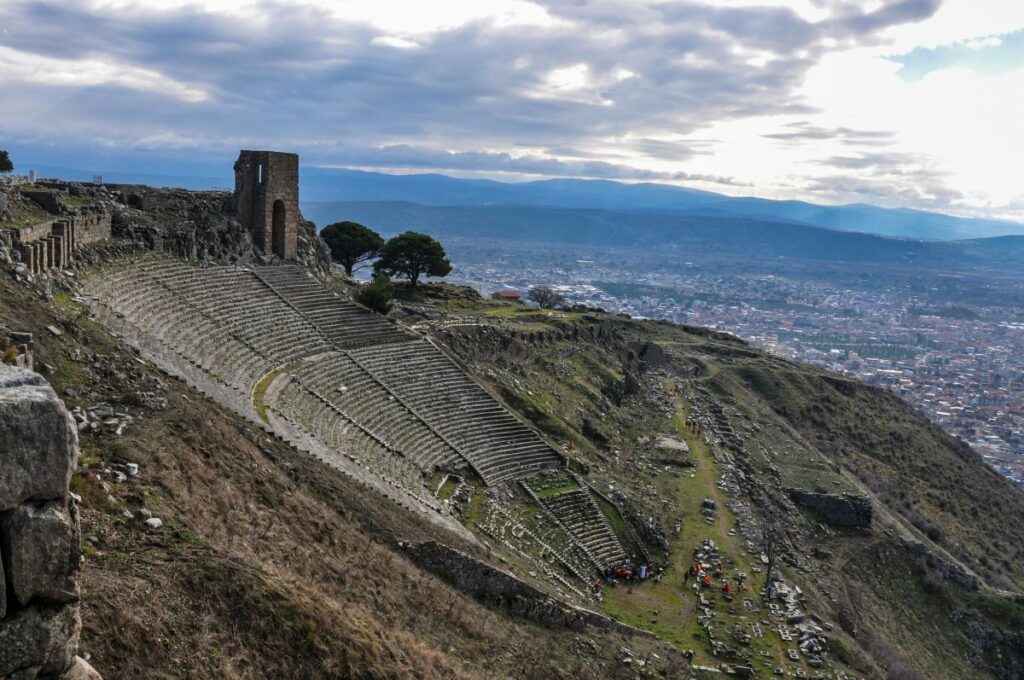
Pergamon was a major Hellenistic and Roman center, famous for its acropolis, library, temples, theater, and healing sanctuary. In Revelation, Pergamon is described as the place “where Satan’s throne is” (Revelation 2:13), a phrase often associated with the city’s intense imperial cult and pagan religious landscape.
What to See in Pergamon
Visit the Acropolis of Pergamon, dramatically located above the modern town of Bergama. Explore the steep ancient theater, the remains of temples, royal structures, and the site associated with the famous Altar of Zeus.
Also visit the Red Basilica, a massive Roman temple later converted into a Christian church. The Asclepieion, one of the great healing centers of antiquity, adds another layer to Pergamon’s importance. Here, religion, medicine, dreams, and healing rituals came together in the ancient world.
To explore one of the most important cities of the ancient world in greater detail, read our guide to Ancient Cities in Turkey.
Biblical Connection
Pergamon represents the challenge of faith in a powerful pagan and imperial environment. Its message in Revelation reflects the pressure early Christians faced in cities where emperor worship and traditional cults were deeply embedded in civic life.
Overnight: Bergama or Izmir
Day 3 – Thyatira and Sardis
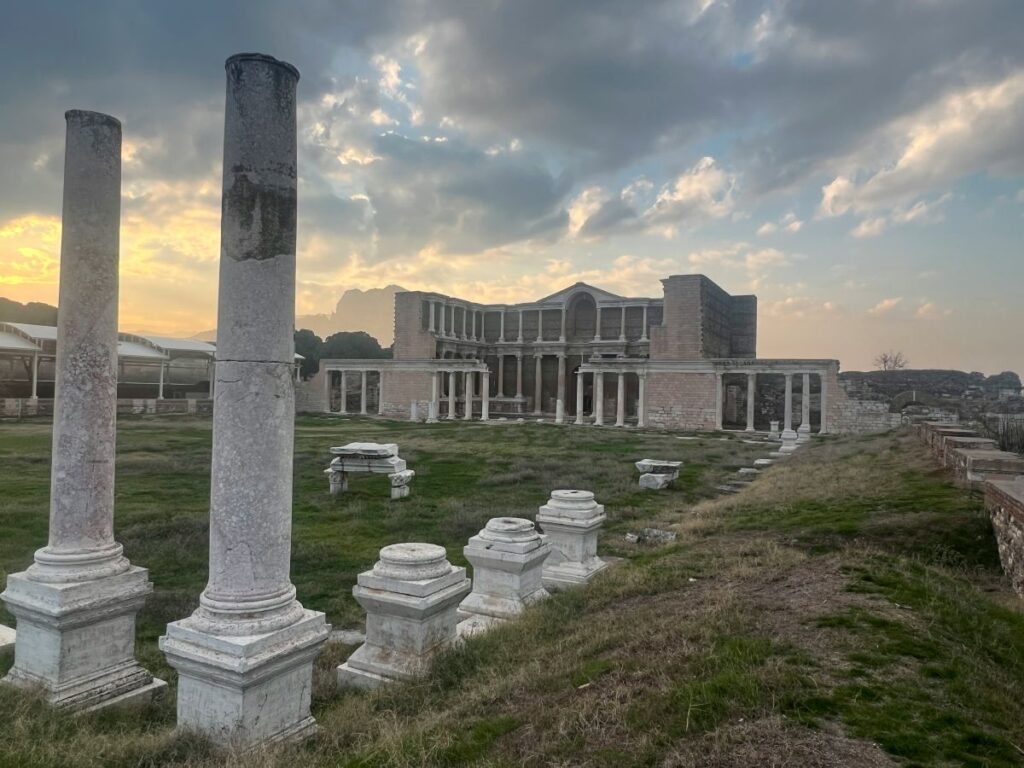
Today’s journey follows the inland route through two more of the Seven Churches: Thyatira and Sardis.
Begin with Thyatira, located in modern Akhisar. Compared with Ephesus or Pergamon, Thyatira has fewer visible ruins, but its Biblical importance is significant. It was a commercial city known for trade guilds, textiles, dyeing, and craftsmanship.
Thyatira is also connected indirectly with Lydia, the seller of purple cloth mentioned in Acts 16. Lydia was from Thyatira and became one of the first Christian converts in Europe after meeting Paul in Philippi. This connection links Thyatira with the spread of Christianity through commerce, travel, and personal networks.
In Revelation, the church of Thyatira receives both praise and warning. It is praised for love, faith, service, and perseverance, but also warned about moral compromise.
Continue to Sardis, one of the most fascinating archaeological sites in western Turkey.
Sardis was the capital of the ancient Lydian Kingdom and the city of King Croesus, famous for his wealth. It was also the birthplace of coinage, making it one of the most important cities in the history of commerce.
By the Roman period, Sardis was still an impressive city, with a monumental gymnasium, bath complex, synagogue, and temples. For Christian travelers, Sardis is especially meaningful because it is one of the Seven Churches of Revelation.
Biblical Connection
The message to Sardis is one of the strongest warnings in Revelation: “You have a name that you live, and are dead” (Revelation 3:1). This phrase gives Sardis a powerful spiritual symbolism. The city looked alive and prosperous, yet the Biblical message speaks of spiritual decline and the need for renewal.
Sardis is also featured in our in-depth article about Biblical Sites in Turkey.
What to See in Sardis
Visit the impressive Roman Gymnasium, the ancient synagogue, the Temple of Artemis, and the remains of the ancient city. Sardis is one of the best places to understand how Jewish, pagan, and Christian communities lived side by side in Roman Asia Minor.
Overnight: Alasehir, Salihli, or Pamukkale area
Day 4 – Philadelphia and Laodicea
This morning, continue east to Philadelphia, one of the Seven Churches of Revelation and one of the most encouraging messages in the entire book. Founded during the Hellenistic period and named in honor of the Attalid ruler Attalus II Philadelphus, Philadelphia stood along important trade routes connecting the Aegean coast with the interior of Anatolia.
Compared with some of the other Seven Churches, Philadelphia preserves relatively modest visible remains today, yet its spiritual significance is profound. In Revelation, the church receives no rebuke. Instead, it is praised for steadfast faithfulness despite limited strength. Christ declares, “I have set before you an open door” (Revelation 3:8), a phrase that has inspired generations of believers and pilgrims.
From Philadelphia, continue south to Laodicea on the Lycus, one of the most impressive and rapidly restored Biblical sites in Turkey. In the Roman period, Laodicea was a wealthy banking center renowned for its black wool textiles, medical school, and eye salve.
Laodicea is perhaps the best known of the Seven Churches because of the famous warning in Revelation: “Because you are lukewarm, and neither hot nor cold, I will spit you out of my mouth” (Revelation 3:16). This message becomes especially vivid when understood in the local context. Nearby Hierapolis was famous for its hot thermal waters, while Colossae was known for cold mountain streams. By the time water reached Laodicea through aqueducts, it had become lukewarm—a striking metaphor that would have resonated deeply with local Christians.
What to See in Laodicea
Explore the two ancient theaters, the stadium, monumental streets, bath complexes, and one of the earliest known church structures in Anatolia. Ongoing excavations have transformed Laodicea into one of the most rewarding archaeological sites in Turkey for Biblical travelers.
Laodicea is one of the most impressive archaeological sites in western Anatolia and a highlight of our Biblical Sites in Turkey guide.
Biblical Connection
Laodicea is also linked to the Epistle to the Colossians, where Paul the Apostle asks that his letter be read among the believers in Laodicea (Colossians 4:16).
Overnight: Pamukkale or Denizli
Day 5 – Hierapolis and Colossae
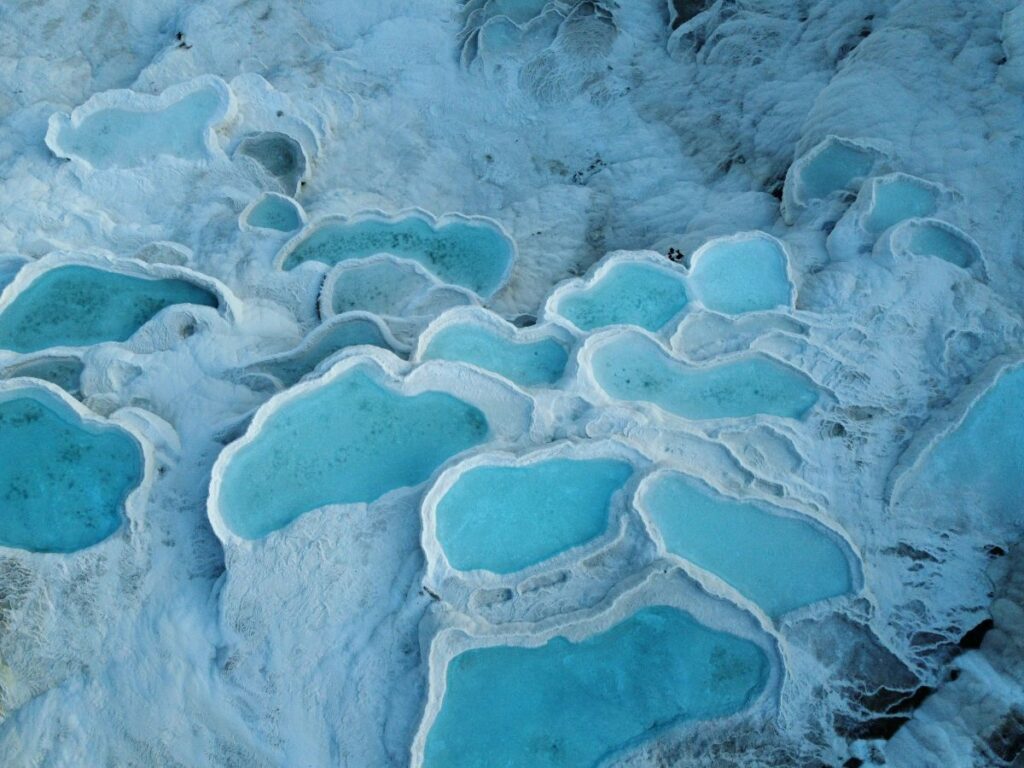
Today is devoted to two of the most significant early Christian centers in the Lycus Valley: Hierapolis and Colossae. Together with Laodicea, these cities formed a closely connected spiritual and commercial network in Roman Asia Minor.
Begin the day in Hierapolis, dramatically situated above the white travertine terraces of Pamukkale. Founded in the Hellenistic period and later transformed into a flourishing Roman spa city, Hierapolis was famous for its thermal waters and sacred atmosphere. The city also became one of the most important Christian centers in Anatolia.
According to early Christian tradition, Philip the Apostle was martyred here. His memory remained so important that a large pilgrimage complex and octagonal church were constructed over the presumed burial site. For many Christian travelers, Hierapolis is one of the most moving places in Turkey because it combines monumental archaeology, natural beauty, and apostolic tradition.
The city’s spectacular theater, extensive necropolis, colonnaded streets, and martyrion of St. Philip offer a vivid picture of how classical and Christian worlds overlapped. Standing on the terraces and looking across the valley, it is easy to understand why this landscape inspired both religious devotion and a sense of wonder.
In the afternoon, continue to nearby Colossae, located near modern Honaz. Although the visible remains are limited and the site remains largely unexcavated, Colossae occupies a central place in New Testament history. Paul the Apostle addressed the Christian community here in the Epistle to the Colossians, one of the most theologically rich letters of the New Testament.
Paul’s words continue to resonate deeply: “He is before all things, and in him all things hold together” (Colossians 1:17). For many believers, visiting the landscape of Colossae creates a powerful connection to the world in which these foundational teachings were first received.
What to See
- Hierapolis ancient city
- Pamukkale travertines
- Martyrium of St. Philip
- Colossae archaeological mound
For practical travel tips, see our complete guide to Best Things to Do in Pamukkale.
Biblical Connection
Hierapolis and Colossae are repeatedly linked in Paul’s writings and in early Christian tradition. Together with Laodicea, they illustrate how closely connected the first Christian communities of Anatolia were.
Overnight: Pamukkale or Denizli
Day 6 – Journey to Pisidian Antioch
After exploring the Lycus Valley, the itinerary turns inland toward the mountains of southwestern Anatolia. Today’s drive from Pamukkale to Pisidian Antioch is one of the most meaningful transitions of the entire journey, because it follows the path of Paul the Apostle from the coastal cities of Asia Minor into the interior regions where the Gospel took root among both Jewish and Gentile communities.
The journey itself reveals an often-overlooked aspect of Biblical Turkey. Early Christian missionaries did not travel only through famous ports such as Ephesus; they also crossed mountain passes, high plateaus, and remote Roman roads to reach communities deep in Anatolia. By driving this route, modern travelers gain a more vivid appreciation for the scale and determination of Paul’s missionary work.
Pisidian Antioch, founded as a Hellenistic settlement and later developed into a Roman colony, became one of the most important centers of early Christianity in Anatolia. Although not one of the Seven Churches of Revelation, it occupies a central place in the Book of Acts and in the story of Paul’s first missionary journey.
According to Acts 13, Paul entered the synagogue of Pisidian Antioch and delivered one of his most significant recorded sermons. In this message, he summarized the history of Israel and proclaimed Jesus as the promised Messiah. The response was dramatic: many Gentiles embraced the message, while opposition also arose. The text records one of the most memorable moments in Paul’s ministry: “The word of the Lord was spreading through the whole region” (Acts 13:49).
What to See in Pisidian Antioch
Upon arrival in modern Yalvac, visitors can explore the extensive archaeological remains, including the monumental city gate, colonnaded streets, the Augusteum, the theater, and the traditional site known as St. Paul’s Church. The nearby museum provides additional context and artifacts from the region.
Spiritual Significance
Pisidian Antioch marks a turning point in Christian history. It was here that Paul’s mission to the Gentiles gained new momentum, helping transform Christianity from a regional movement into a faith destined to spread across the Roman world.
For many pilgrims, standing among the ruins of this inland Roman colony evokes a powerful sense of connection to the moment when the Christian message began to reach beyond its original cultural boundaries.
Overnight: Yalvac or Isparta
Day 7 – Pisidian Antioch and St. Paul’s Sermon
Today is dedicated to a deeper exploration of Pisidian Antioch, one of the most important locations in the missionary journeys of Paul the Apostle. While many travelers focus on the Seven Churches of Revelation, Pisidian Antioch offers an equally profound connection to the spread of Christianity into the heart of the Roman world.
In the synagogue of this Roman colony, Paul delivered one of the longest sermons recorded in the Acts of the Apostles. He traced the story of Israel from the patriarchs to David and proclaimed Jesus as the fulfillment of God’s promises. This sermon represents a pivotal moment in Christian history, articulating the Gospel to a diverse audience of Jews and Gentiles.
The response was extraordinary. Acts records that many listeners were deeply moved and returned the following Sabbath to hear more. The narrative culminates with a statement that captures the momentum of the early Church: “Almost the whole city gathered to hear the word of the Lord” (Acts 13:44).
What to See
Spend the day walking through the remarkably extensive ruins of Pisidian Antioch. Highlights include:
- The monumental western gate
- Colonnaded streets
- The Augusteum dedicated to Emperor Augustus
- Roman baths
- The theater
- The traditional site associated with St. Paul’s Church
The archaeological remains vividly illustrate the urban setting in which Paul preached and where one of the earliest and most influential Gentile Christian communities emerged.
Spiritual Significance
Pisidian Antioch symbolizes the universal dimension of Christianity. Paul’s words here emphasize that the message of Christ was intended not only for one people, but for all nations. This idea became one of the defining themes of Christian theology and mission.
Travel Notes
Because the site is expansive and less visited than Ephesus or Pamukkale, it offers a quiet and contemplative atmosphere. Many pilgrims consider it one of the most spiritually moving stops in Biblical Turkey.
Overnight: Yalvac or Isparta
Day 8 – Perge and Arrival in Antalya
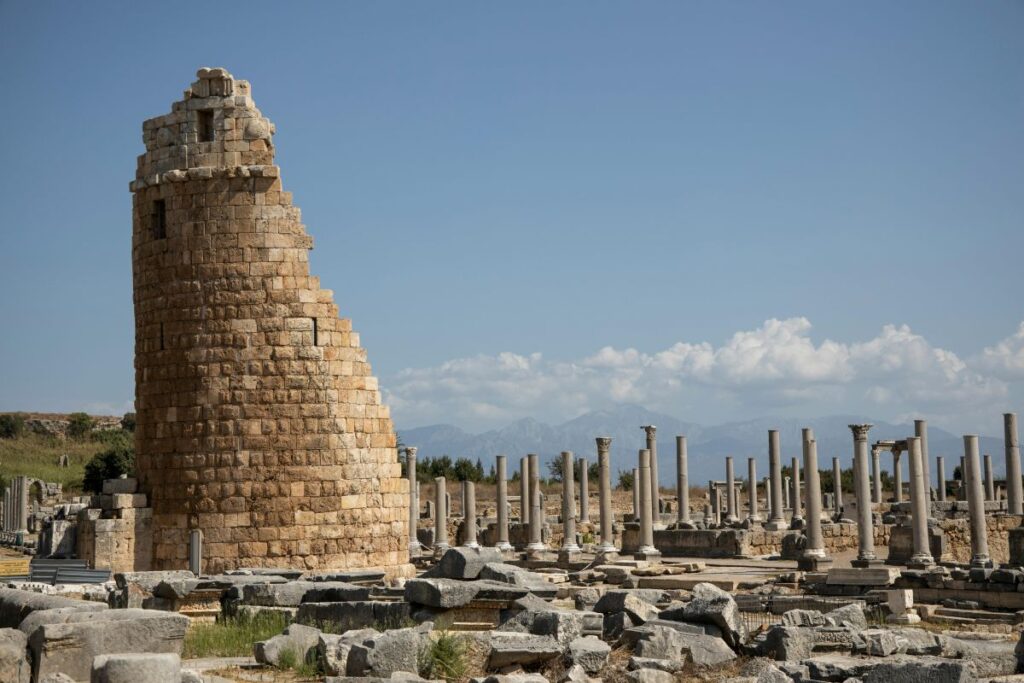
Today the journey descends from the Anatolian plateau toward the Mediterranean coast, following one of the most important routes in the missionary travels of Paul the Apostle and Barnabas. The destination is Perge, one of the most impressive Roman cities in southern Turkey and a significant stop in the Book of Acts.
Perge was the capital of ancient Pamphylia and one of the great urban centers of Roman Anatolia. Broad colonnaded streets, monumental gates, baths, a stadium, and one of the largest theaters in the region reveal the prosperity and sophistication of this remarkable city.
According to Acts 13 and 14, Paul and Barnabas passed through Perge during their first missionary journey. After traveling from Cyprus to Pamphylia, they landed nearby and continued inland toward Pisidian Antioch. Later, after completing their mission, they returned to Perge and preached there before departing from the coast.
The Book of Acts records simply but powerfully: “When they had spoken the word in Perga, they went down to Attalia” (Acts 14:25). Attalia is modern Antalya, where the missionaries sailed onward after one of the most significant journeys in early Christian history.
What to See in Perge
Explore the Hellenistic gates, the magnificent colonnaded avenue with its central water channel, the Roman baths, the agora, the stadium, and the theater. Perge offers one of the clearest and most impressive examples of Roman urban planning in Turkey.
Spiritual Significance
Perge marks both the beginning and conclusion of a crucial chapter in Paul’s ministry. It symbolizes movement, mission, and the determination to carry the Christian message from coastal ports to distant inland communities.
After visiting Perge, continue to Antalya, the ancient Attalia and one of the most beautiful cities on the Mediterranean coast.
Overnight: Antalya
Day 9 – Antalya, Aspendos and Time for Reflection
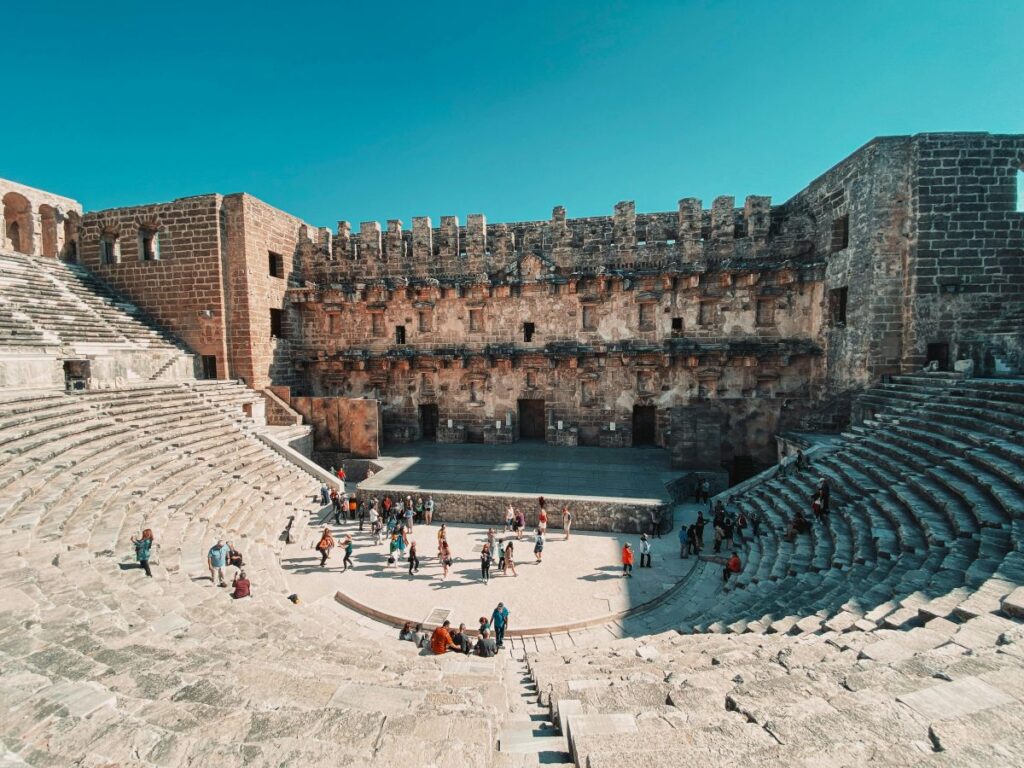
After several days of intensive travel through the landscapes of early Christianity, today offers a more relaxed pace based in Antalya, ancient Attalia. This city occupies a special place in the missionary journeys of Paul the Apostle and Barnabas, who sailed from this harbor after completing their first mission through Anatolia.
Acts 14:26 records that from Attalia they “sailed to Antioch, where they had been committed to the grace of God for the work they had now completed.” This verse makes Antalya not simply a pleasant coastal destination, but the symbolic conclusion of one of the most significant missionary journeys in Christian history.
In the morning, you may choose to visit Aspendos, home to the best-preserved Roman theater in the world. Although Aspendos is not directly mentioned in the Bible, it provides a vivid illustration of the broader Greco-Roman cultural world in which the apostles traveled and preached. Standing in its immense theater helps visitors imagine the public spaces where ideas, performances, and religious debates shaped ancient society.
Alternatively, you may spend the day exploring Antalya’s historic harbor, known today as Kaleiçi. Walking through the old town and looking over the Mediterranean offers an opportunity to reflect on the journey from Ephesus to the Seven Churches, the Lycus Valley, and the highlands of Pisidia.
Optional Experiences
- Aspendos
- Kaleici
- Hadrian’s Gate
- Mediterranean coastline and harbor views
Spiritual Significance
Antalya, ancient Attalia, represents the completion of Paul’s first missionary journey. After months of travel, preaching, hardship, and discovery, this harbor became the point from which the apostles returned and reported “all that God had done with them” (Acts 14:27).
For many travelers, this final full day serves as both a historical conclusion and a spiritual moment of reflection on the remarkable spread of Christianity across Asia Minor.
Overnight: Antalya
Day 10 – Departure from Antalya and Final Reflections
Your Biblical Turkey Itinerary concludes in Antalya, ancient Attalia, where Paul the Apostle and Barnabas completed one of the most influential missionary expeditions in Christian history. As you prepare to depart from Antalya Airport, it becomes clear that this itinerary is far more than a sightseeing tour. It is a journey through the landscapes where the early Church was formed and where the message of Christianity began to spread throughout the Roman world.
Over the past ten days, you have walked the marble streets of Ephesus, reflected on the steadfast faith of the believers in Smyrna Agora, stood on the acropolis of Pergamon, and explored the communities addressed in the Book of Revelation. You have traveled through the fertile valleys of western Anatolia to Laodicea on the Lycus, Hierapolis, and Colossae, and then followed Paul into the highlands of Pisidian Antioch and down to Perge and Attalia.
These places reveal that the New Testament was rooted in real cities, real roads, and real communities. The letters of Paul, the messages of Revelation, and the stories recorded in Acts were written to people who lived in the landscapes you have just explored.
For Christian travelers, Biblical Turkey offers an extraordinary opportunity to connect Scripture with geography and archaeology. Few destinations in the world allow visitors to experience so many foundational sites of early Christianity within a single journey.
Suggested Extensions
If you have additional time, consider extending your pilgrimage to:
- Cappadocia and its rock-cut churches
- Antakya (Ancient Antioch), where followers of Jesus were first called Christians
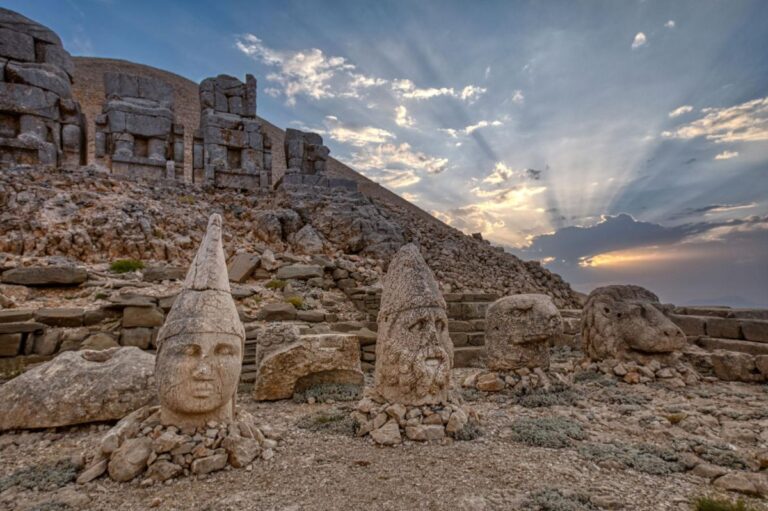
- Mount Nemrut for its extraordinary Commagene sanctuary
- Gobeklitepe, the world’s oldest known temple complex
To continue exploring Turkey’s extraordinary religious and archaeological heritage, read our guides to Gobeklitepe, Karahantepe, and Mesopotamia.
Final Spiritual Reflection
The apostle Paul wrote to believers in the region, “The word of the Lord was spreading through the whole region” (Acts 13:49). That simple statement captures the essence of this journey. From the bustling port of Ephesus to the mountain roads of Pisidia and the harbors of Pamphylia, Anatolia became one of the great crossroads of Christian history.
A pilgrimage through Biblical Turkey is therefore more than a tour of ancient ruins. It is an encounter with the places where faith was tested, communities were formed, and the message of Christianity began to transform the world.
Biblical quotations in this article are referenced from Bible Gateway.