
Ask a Guide · TripInTurkey
Questions About Turkey: What Travelers Ask Me on Tours
Some questions come up while we are walking through an ancient city. Others arrive over lunch, on the way to a balloon flight, or when someone notices a row of tiny holes in a cliff.
These are real questions about Turkey that travelers have asked me on tours. Here are the answers I give, with a little more room for the explanations.
Traveling in Turkey
Which countries border Turkey?
Turkey has eight land neighbours: Greece and Bulgaria to the west; Georgia to the northeast; Armenia, Azerbaijan and Iran along its eastern side; and Iraq and Syria to the south and southeast.
The border with Azerbaijan sometimes surprises visitors. It is with Nakhchivan, an Azerbaijani exclave separated from the main part of that country. Looking at a map helps explain why Turkey has so many connections with southeastern Europe, the Caucasus and the Middle East.
What is Turkey's coastline like? Are the beaches beautiful?
Yes, Turkey has a wide choice of beautiful beaches, with very different coastal landscapes. The country has shores on the Black Sea, the Sea of Marmara, the Aegean and the Mediterranean. The Aegean and Mediterranean coasts are particularly popular for beach holidays, with a mixture of sandy beaches, pebbly bays and rocky coves.
In the 2026 Blue Flag awards, 580 Turkish beaches received the designation. The programme assesses swimming-water quality, environmental management, education and safety, among other criteria.
One of the pleasures of the western and southern coasts is combining time by the sea with history. Places such as Side, Patara and Phaselis bring ancient streets, theatres or other ruins close to the coast. In many areas, it is possible to spend part of the day swimming and another part exploring an ancient city.
For ideas on choosing an area, see my guide to Turkey's beach destinations.
Is it safe to go out in the evening in Turkey?
In the places where I guide visitors, going out for dinner and an evening walk is a normal part of a trip. I have walked around many times in the evening, including on my own, and I have not personally experienced problems.
That is my own experience, and it is why I feel comfortable encouraging visitors to enjoy the places they are staying. People are often helpful, and a simple question can turn into a friendly conversation.
Use the same common sense you would elsewhere: choose well-lit, busy streets, keep track of your belongings and use reputable transport when returning late. Conditions vary between neighbourhoods, so your hotel or local guide can help with advice about a particular route. Those ordinary precautions leave plenty of room to enjoy an evening out.
What should female travelers wear in Turkey?
For everyday sightseeing in Cappadocia and the main tourist destinations, choose clothing that feels comfortable and suits the weather and activity. Shorts, skirts, dresses and trousers are all common choices. Women do not need to cover their hair in public.
You will also see Turkish women wearing many different styles, including women who wear a headscarf and women who do not. Personal choices and local customs vary.
Turkey's constitution establishes equal rights for women and men. Women gained the right to vote and stand in national parliamentary elections on 5 December 1934, earlier than in several other European countries.
When visiting a mosque, follow the dress requirements of that place of worship. Wear clothing covering the shoulders, arms and legs; women should also cover their hair. A light scarf is useful to carry on sightseeing days that include a mosque visit.
Cappadocia: Caves, Landscape and Balloon Flights
Does it snow in Cappadocia?
Yes, it does. Cappadocia is in inland Central Anatolia, on a high plateau with a continental climate. Nevşehir itself stands at about 1,150 metres above sea level, and elevations vary between the towns and valleys. Winters can be cold and snowy.
The landscape can look completely different under snow, with white covering the tops of the fairy chimneys and outlining the valleys. However, snow cover varies from year to year, so a winter visit does not guarantee a snowy landscape.
Turkey has several different climates. The Aegean and Mediterranean coasts generally have milder winters, helped by the sea. Inland, elevation and mountain barriers also affect temperatures. Weather on the coast is therefore a poor guide to what you should pack for Cappadocia.
What should we wear for a hot-air balloon flight in Cappadocia?
Dress for the season, and wear layers that you can adjust. The coldest part of the experience is often the early start and the time spent outdoors before takeoff. Even in summer, it is sensible to bring a light jacket or another warm layer.
Comfortable trousers and flat, closed shoes, such as trainers or walking shoes, are practical choices. You need to move comfortably while getting into the basket, and the ground at the launch and landing sites can be uneven.
In winter, bring proper cold-weather clothing, including a warm coat, gloves and a hat. Check the morning forecast and follow your balloon company's clothing advice when preparing for the flight.
Do people still live in caves in Cappadocia?
Yes, some people still live in homes that include rock-cut rooms, although this is much less common than it used to be. Cave dwellings were still a familiar part of family life in the 1980s.
A cave home can also be part of a larger property, with rooms carved into the rock connected to stone-built sections. The word “cave” does not necessarily describe the whole house.
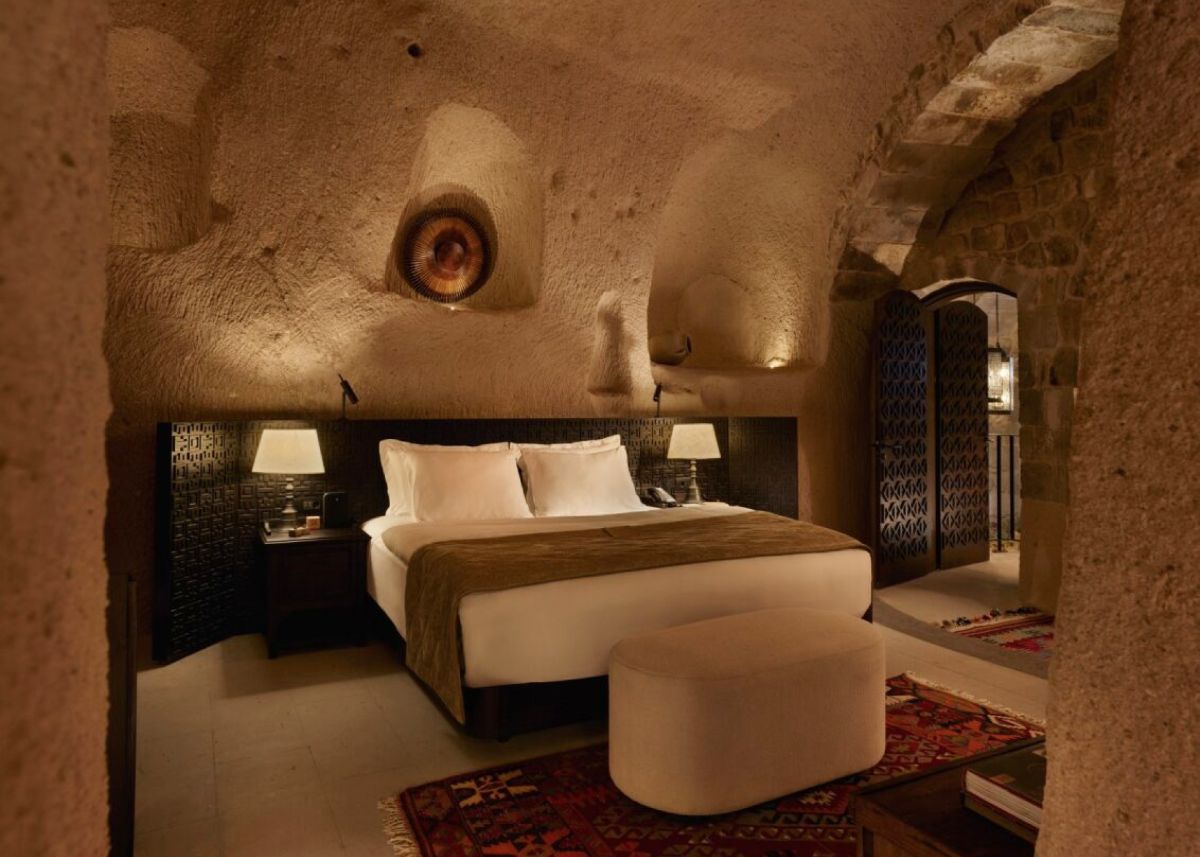
Rock-cut spaces also continue to be used for storage, including food supplies. Tourism has brought another use: many restored properties now contain cave hotel rooms. This is an established part of Cappadocia's tourism history, rather than a completely new development.
The cave hotels visitors stay in are generally within established towns and villages. My guide to where to stay in Cappadocia explains the differences between these places.
What are all those little holes in the rocks?
Many of the small openings you see grouped together in the cliffs are entrances to pigeon houses, called güvercinlik in Turkish.
People carved spaces for pigeons to roost and collected their droppings to use as fertiliser. This was valuable for local agriculture, including the vineyards. Behind a few small openings there may be a much larger chamber with places for the birds to settle.
So these holes tell us something about working life in Cappadocia: the rock was useful for farming as well as for houses and churches. Pigeon Valley, between Göreme and Uçhisar, is a particularly good place to notice them.
Other openings can belong to homes, storerooms or religious buildings, so the purpose depends on the particular structure.
Are Cappadocia's caves natural or made by people?
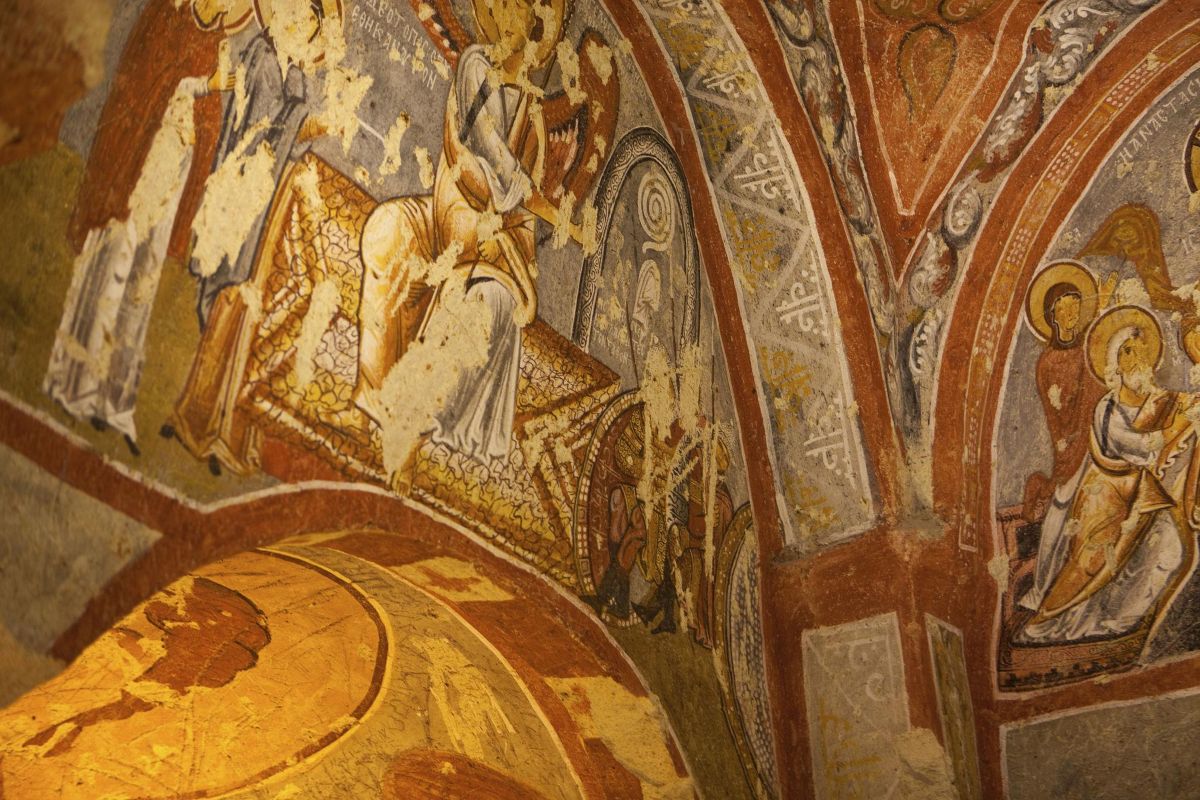
The historical rooms, churches, storerooms and underground passages that visitors usually mean by “caves” were carved by people.
The landscape provided the material. Much of the rock is volcanic tuff, which can be excavated with hand tools such as picks and chisels. Over generations, people created rooms, connected passages, and adapted existing spaces for different purposes.
These places were developed and reused by different communities over long periods. There is no single builder or date that explains every rock-cut structure in Cappadocia.
You can see how extensive this work became in the underground cities of Cappadocia.
Did someone put the “hats” on the fairy chimneys?
No, those caps are natural, although I understand why people ask!
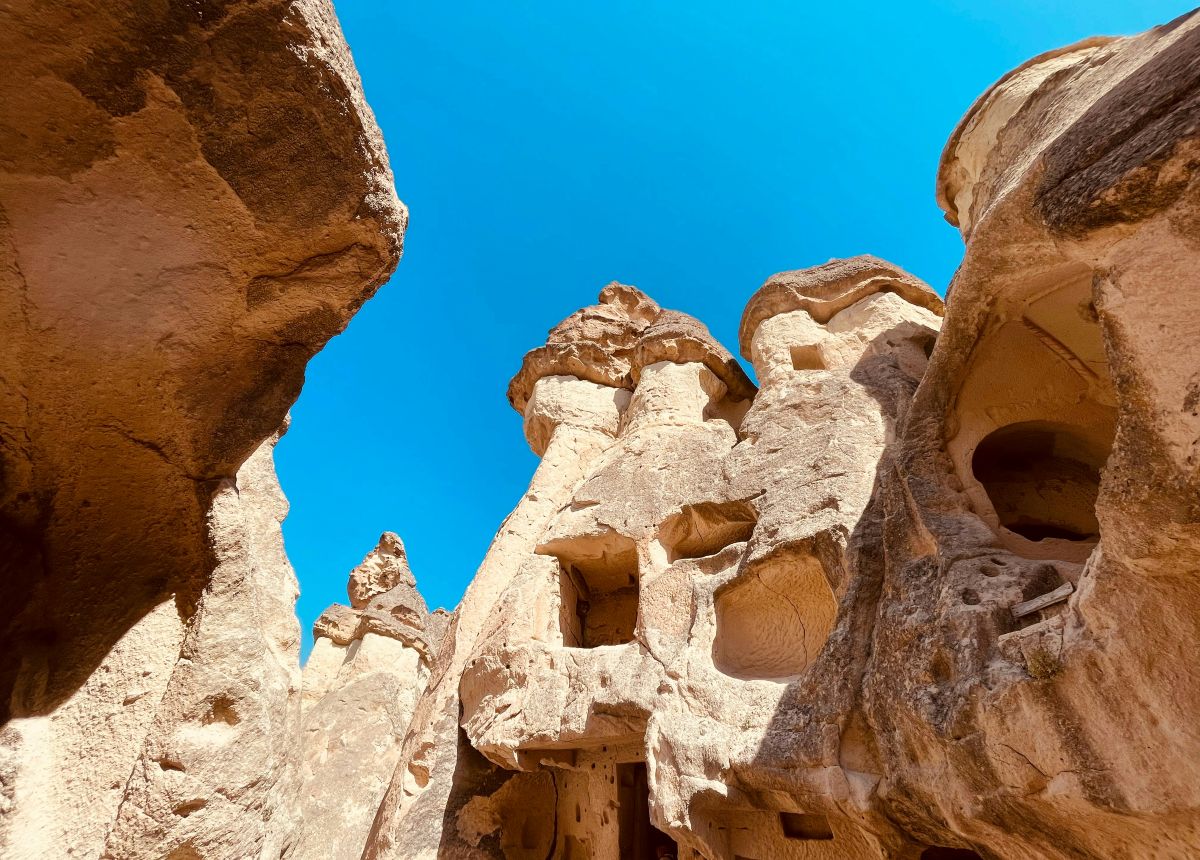
Volcanic activity left different deposits across the region. Over time, erosion wore these materials away at different rates. Where a more resistant cap protected the softer material underneath, a column could remain while the surrounding ground was gradually removed.
That difference in resistance helps explain the familiar mushroom-shaped fairy chimneys. The precise materials and shapes vary from place to place.
Rain, runoff and weathering continue to change the formations. The cap and column are parts of a changing natural landscape, even when they look as though someone carefully balanced one stone on top of another.
Food, Culture and Sport
How can alcohol be sold in Turkey if most people are Muslim?
Turkey is a Muslim-majority country, and its constitution defines it as a secular republic. Alcohol can legally be sold by licensed businesses, and adults decide for themselves whether to drink.
Religious practice and personal choices vary. Some people avoid alcohol because of their beliefs, while others drink. Being Turkish, or identifying as Muslim, does not tell you everything about a person's daily life.
You will find restaurants and shops selling alcohol, alongside businesses that choose not to serve it. Cappadocia also has a longstanding wine tradition, which is closely connected to the region's vineyards and grape growing.
Which foods should we try in Cappadocia and Turkey?
In Cappadocia, testi kebabı is one of the best-known dishes: meat and vegetables cooked in a sealed clay pot. Mantı, small filled dumplings, are another dish to look for, with different versions across Central Anatolia. The region is also known for pumpkin seeds, grapes, grape molasses and wine.
Across Turkey, visitors often recognise kebabs and meze first. At home, however, Turkish cooking includes a much wider range of everyday dishes. Lentils, chickpeas, beans, seasonal vegetables, soups, rice and bulgur all have a place at the table.
Dolma and sarma are worth trying too, whether that means stuffed vegetables or wrapped vine leaves. For dessert, baklava is the most internationally recognised choice, but it is only one part of a much larger tradition of pastries, milk desserts and regional sweets.
My suggestion is to try some of the everyday dishes as well as the famous restaurant specialities. You can explore more in my Turkish food guide.
What is the most popular sport in Turkey?
Football is the big one, and I am a Galatasaray supporter, so you may get an enthusiastic answer if you ask me about it!
Football is a common subject of conversation, and support for clubs can be very passionate. Galatasaray fans set a then-world-record stadium crowd roar of 131.76 dBA in 2011. That gives you an idea of the atmosphere supporters can create.
Women's volleyball also has a particularly strong following. The national team, widely known as the “Sultans of the Net,” won consecutive European Championship titles in 2023 and 2026. Their achievements have made volleyball an important part of sporting conversations in Turkey.
Basketball is another sport people follow closely, at both club and national-team level. Football, volleyball and basketball are therefore good starting points if you want to talk sport with people you meet.
Family Life and Education
Can women get divorced in Turkey, and how common is divorce?
Yes. Women can file for divorce through the civil courts, just as men can. Turkish law gives either spouse the right to bring a divorce case when the relevant legal grounds apply.
According to TurkStat, 193,793 couples divorced in 2025. The crude divorce rate was 2.26 divorces per 1,000 residents. This measures divorces relative to the whole population. Rates also vary between different parts of Turkey.
Property division needs a little explanation. Under the default marital property regime, each spouse generally has a claim to half of the other's remaining net acquired property when the regime is settled. Property owned before that regime began, gifts and inheritances are generally treated as personal property. Debts, the relevant dates, any valid property agreement and the circumstances of the case can affect the outcome.
How many children do families in Turkey usually have?
Families are generally getting smaller, and I can see that change across the generations in my own family.
My grandmother grew up in a family with eight children. Both my mother and my father grew up in families with four children. I have one sibling. Of course, one family cannot represent the whole country, but it is a simple way to explain the change visitors often ask about.
The national statistics show falling fertility too. TurkStat reported a total fertility rate of 1.42 children per woman for 2025, compared with 2.38 in 2001.
This is a statistical measure based on the birth rates of that year, rather than the average number of children in every existing family. Individual choices and circumstances vary considerably, including between regions and generations. Some families have several children, while others have one child or none.
Is education expensive in Turkey?
Public primary and secondary schools do not charge tuition. Private schools also exist, and their fees vary widely. Families can still have expenses such as transport, meals and school materials, so tuition-free schooling does not mean every cost disappears.
For some working parents, the timetable is an important reason to consider a private school. Some offer supervision and activities into the late afternoon, sometimes until around 17:00 or 18:00. Public primary schools may finish earlier, for example around 15:00, but hours depend on the individual school and whether it operates a single or double shift.
A good state school can be a very good option when its teaching and timetable suit the family. The practical choice depends on the particular school, the child's needs and the family's arrangements.
At university level, Turkish students in regular daytime programmes at state universities generally have their contribution fees covered within the standard study period. Exceptions apply, including for some additional programmes or extended study, and different fee rules apply to international students. Foundation universities, often described as private universities, generally charge tuition, with costs varying by institution, programme and scholarship.
What would you like to ask?
A question that occurs to you during a trip may be something other travelers are wondering about too. If there is something you would like explained, send it my way.
Send your questionPlanning a visit? Start with my Cappadocia travel guide.
Sources and further reading
- Constitution of the Republic of Türkiye — secular republic and equality before the law
- Ministry of Agriculture and Forestry — alcohol sales licensing and regulation
- Turkish State Meteorological Service — Türkiye's climates
- Nevşehir AFAD provincial report — geography and elevation
- Lord Balloons — clothing advice for balloon flights
- GoTürkiye — Cappadocia food and wine
- UNESCO — Göreme National Park and the Rock Sites of Cappadocia
- Cappadocia Geopark — Pigeon Valley and dovecotes
- Cappadocia Geopark — Damsa Valley and capped fairy chimneys
- Atatürk Research Center — women's rights during the Atatürk period
- Kuşadası Mufti's Office — rules for mosque visits
- Turkish Ministry of Environment — Türkiye's geography and neighbouring countries
- TÜRÇEV / Blue Flag Türkiye — 2026 awards
- Guinness World Records — Galatasaray's historical stadium crowd record
- CEV — Türkiye retains the Women's EuroVolley title in 2026
- TurkStat — Birth Statistics, 2025
- TurkStat — Marriage and Divorce Statistics, 2025
- Turkish Civil Code — divorce and marital property, Articles 166, 202, 219–220 and 236
- Ministry of National Education — education in Türkiye
- Trabzon University — 2026–2027 contribution fees and exceptions