Turkey is one of the world’s greatest open-air museums. Few countries offer such an extraordinary concentration of ancient cities, temples, theaters, sanctuaries, and monumental tombs within a single national border. From the imperial capitals of the Hittites to the marble avenues of Roman metropolises and the mountaintop shrines of forgotten kingdoms, the lands of Anatolia preserve more than ten thousand years of human history.
For travelers who love archaeology, history, and culture, Turkey is a dream destination.
This vast peninsula, bridging Asia and Europe, served as a crossroads of civilizations for millennia. Hittites, Phrygians, Lydians, Persians, Greeks, Romans, Byzantines, Seljuks, and Ottomans all left their mark on the landscape. As a result, modern Turkey is home to hundreds of ancient settlements, many of them remarkably well preserved and several recognized as UNESCO World Heritage Sites.
Some sites are world famous. Ephesus attracts millions of visitors with its spectacular Library of Celsus and Great Theatre. Troy evokes Homeric legends and the story of the Trojan War. Hattusa reveals the power of the Hittite Empire, while Mount Nemrut crowns a mountain summit with colossal stone heads that seem to watch over southeastern Anatolia.
Other sites remain surprisingly underappreciated. Aphrodisias boasts some of the finest marble sculpture ever produced in the Roman world. Sagalassos rises dramatically in the Taurus Mountains. Termessos offers one of the most atmospheric archaeological experiences in the Mediterranean.
This guide brings together fifteen of the most popular and historically significant ancient cities in Turkey. Each site tells a different chapter of Anatolia’s story and offers a remarkable journey through time.
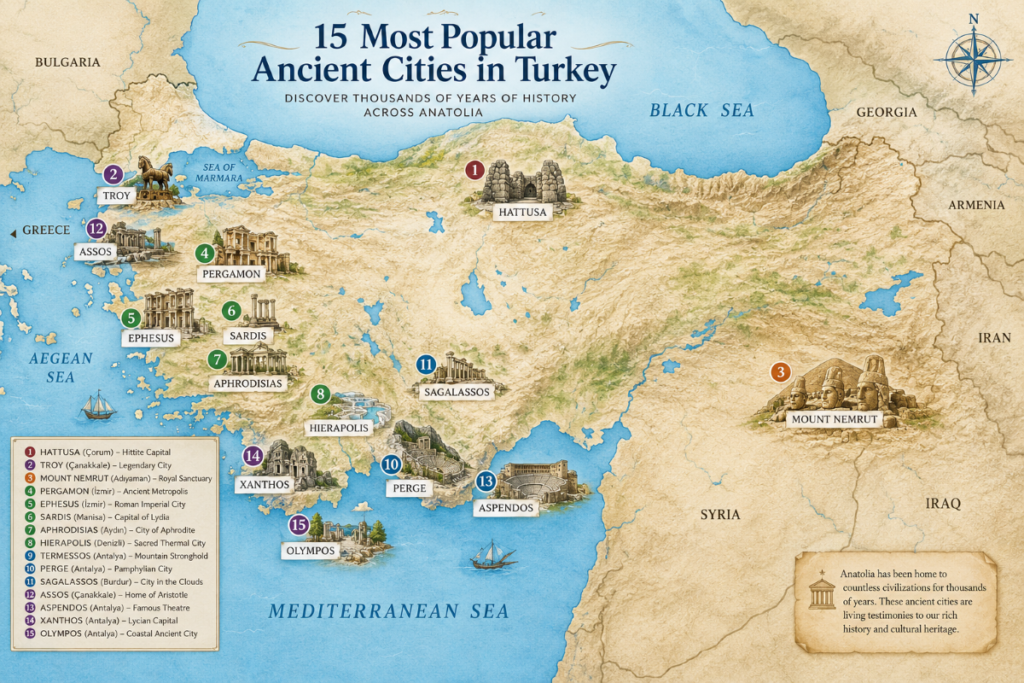
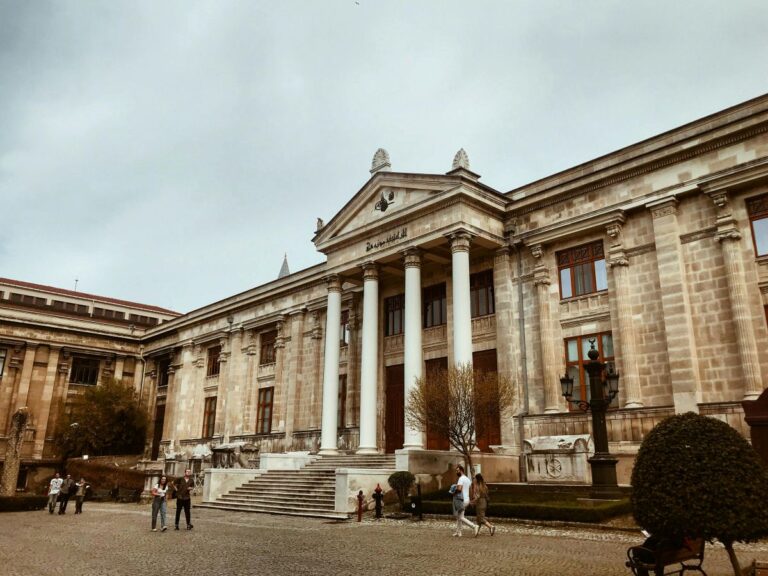
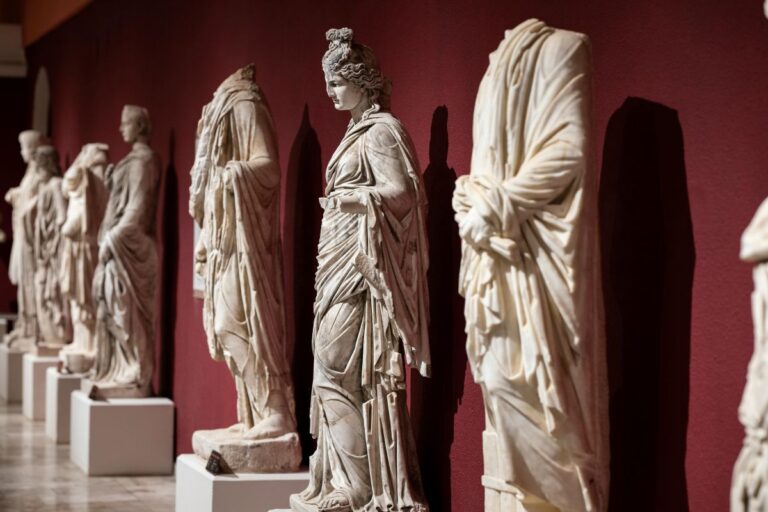
Visiting the archaeological sites themselves is only part of the experience. Many of the sculptures, inscriptions, mosaics, and everyday objects uncovered during excavations are preserved in museums across the country. Our Museums in Turkey guide explains how these collections help complete the story of ancient Anatolia.
Table of Contents
1. Hattusa – Capital of the Hittite Empire
Hattusa was the capital of the Hittite Empire, one of the great Bronze Age powers of the ancient Near East. Located near modern Boğazkale in central Anatolia, this extraordinary city flourished between the 17th and 12th centuries BCE and served as the political, religious, and military center of a civilization that rivaled Egypt, Assyria, and Babylon.
The Hittites were among the earliest Indo-European-speaking peoples and created one of the most sophisticated states of the Late Bronze Age. Their empire stretched across much of Anatolia and northern Syria. They are particularly famous for the Battle of Kadesh against Ramesses II around 1274 BCE and for the peace treaty that followed—widely regarded as one of the earliest known international treaties in world history.
Hattusa was protected by massive fortification walls that extended for several kilometers and included monumental gates decorated with carved lions and sphinxes. Among the most impressive remains are the Lion Gate, the King’s Gate, the Great Temple, and the vast royal citadel at Büyükkale. Nearby Yazılıkaya served as an open-air sanctuary where processions of Hittite gods were carved into the living rock, providing invaluable insight into Hittite religion and cosmology.
Archaeological excavations have uncovered thousands of cuneiform tablets at Hattusa. These texts reveal diplomatic correspondence, legal codes, myths, rituals, and historical records, transforming our understanding of the ancient Near East. Thanks to these discoveries, historians can reconstruct the political and cultural world of Bronze Age Anatolia in remarkable detail.
Recognized as a UNESCO World Heritage Site, Hattusa is one of the most important archaeological sites in Turkey and an essential destination for anyone interested in the origins of Anatolian civilization. Walking through its gates and temples offers a rare opportunity to encounter the legacy of a forgotten empire that once shaped the course of ancient history.
To learn more about the civilization that built Hattusa, read our detailed guide to the Hittite Empire.
2. Troy – The Legendary City of Homer
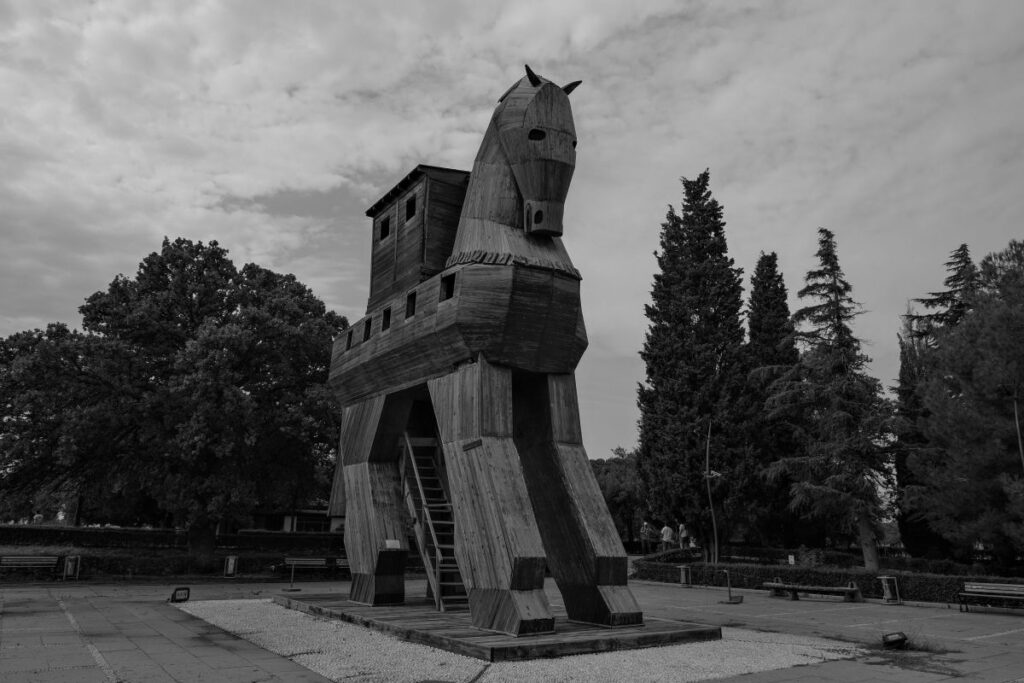
Troy is one of the most famous archaeological sites in the world, immortalized in The Iliad and forever associated with the legendary Trojan War. Located near the Dardanelles in northwestern Turkey, Troy occupied a strategic position between the Aegean Sea and the Black Sea, controlling one of the most important trade routes of the ancient world.
For centuries, Troy was considered little more than myth. That changed in the nineteenth century when excavations led by Heinrich Schliemann uncovered the remains of a multi-layered settlement. Archaeologists discovered that Troy was not a single city but a sequence of at least nine major cities built one atop another, spanning more than four thousand years from the Early Bronze Age to the Roman period.
The most likely candidate for Homer’s Troy is Troy VI or VII, flourishing during the Late Bronze Age around the 13th century BCE. These layers reveal powerful defensive walls, towers, and evidence of destruction, suggesting that the legends may preserve memories of real historical conflicts in western Anatolia.
The site’s imposing stone ramparts, gateways, and foundations demonstrate that Troy was a wealthy and strategically important city. During the Roman era, it became a revered pilgrimage destination because Romans believed they were descendants of the Trojan hero Aeneas.
Today, Troy is a UNESCO World Heritage Site and one of Turkey’s most compelling archaeological destinations. Visitors can explore the ruins, the excellent Troy Museum, and the surrounding landscape that inspired one of humanity’s greatest epics. Few places blend myth, literature, and archaeology as powerfully as Troy.
3. Pergamon – The Great Hellenistic Kingdom of Anatolia
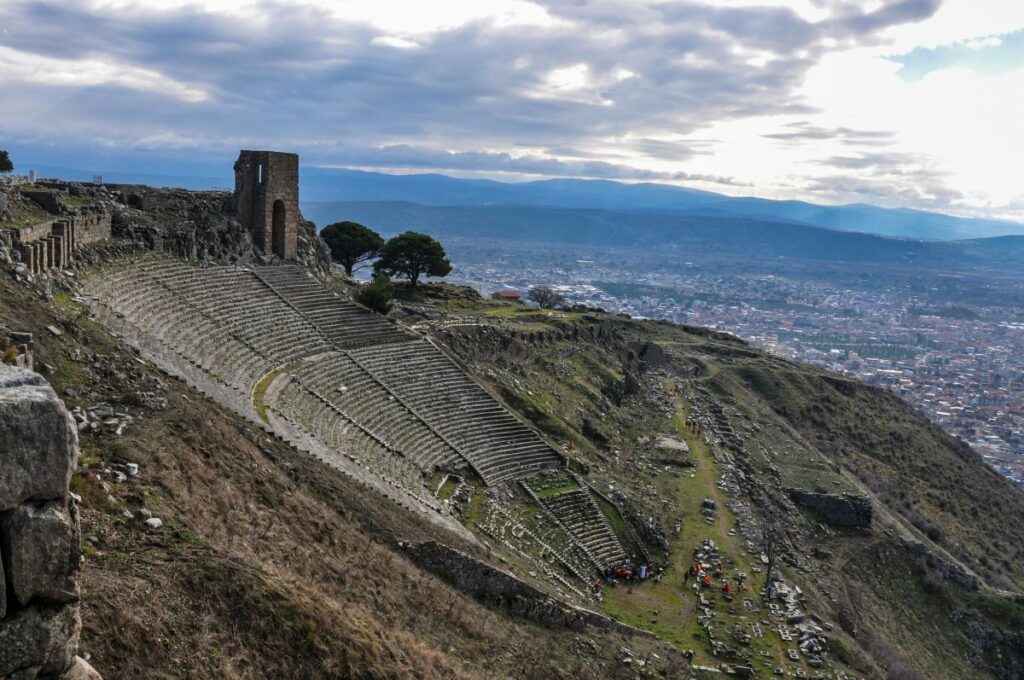
Pergamon was one of the most influential cities of the Hellenistic world and later one of the most important cultural and religious centers of the Roman Empire. Rising dramatically above the modern town of Bergama, this extraordinary ancient city combines royal ambition, scientific innovation, and monumental architecture in one of the most spectacular archaeological landscapes in Turkey.
Pergamon reached its golden age during the 3rd and 2nd centuries BCE under the Attalid dynasty. After the death of Alexander the Great, his empire fragmented into competing kingdoms, and Pergamon emerged as a powerful independent state. The Attalid rulers transformed the city into a brilliant center of art, literature, medicine, and scholarship, consciously rivaling cultural capitals such as Alexandria and Athens.
One of Pergamon’s most celebrated achievements was its vast library, which reportedly housed more than 200,000 scrolls and was second in fame only to the Library of Alexandria. According to ancient tradition, a shortage of Egyptian papyrus encouraged the development and widespread use of parchment, whose name derives from Pergamon itself.
The city’s acropolis crowns a steep hill overlooking the fertile Bakırçay plain. Here visitors can explore the remains of royal palaces, temples, stoas, and one of the steepest and most dramatic theaters of the ancient world, with breathtaking views over western Anatolia. Pergamon was also home to the monumental Altar of Zeus, a masterpiece of Hellenistic sculpture depicting the battle between gods and giants.
In the Roman period, Pergamon remained a major urban center and became famous for the Asclepieion of Pergamon, one of antiquity’s most renowned healing sanctuaries dedicated to Asclepius, the god of medicine. Patients came from across the Mediterranean seeking treatments that combined medicine, psychology, sacred ritual, and dream interpretation.
Pergamon is recognized as a UNESCO World Heritage Site and stands as one of Turkey’s most remarkable archaeological destinations. Its blend of royal architecture, scientific legacy, and religious significance makes it an essential stop for anyone interested in the intellectual and artistic achievements of the ancient world.
4. Ephesus – The Best-Preserved Classical City in the Eastern Mediterranean
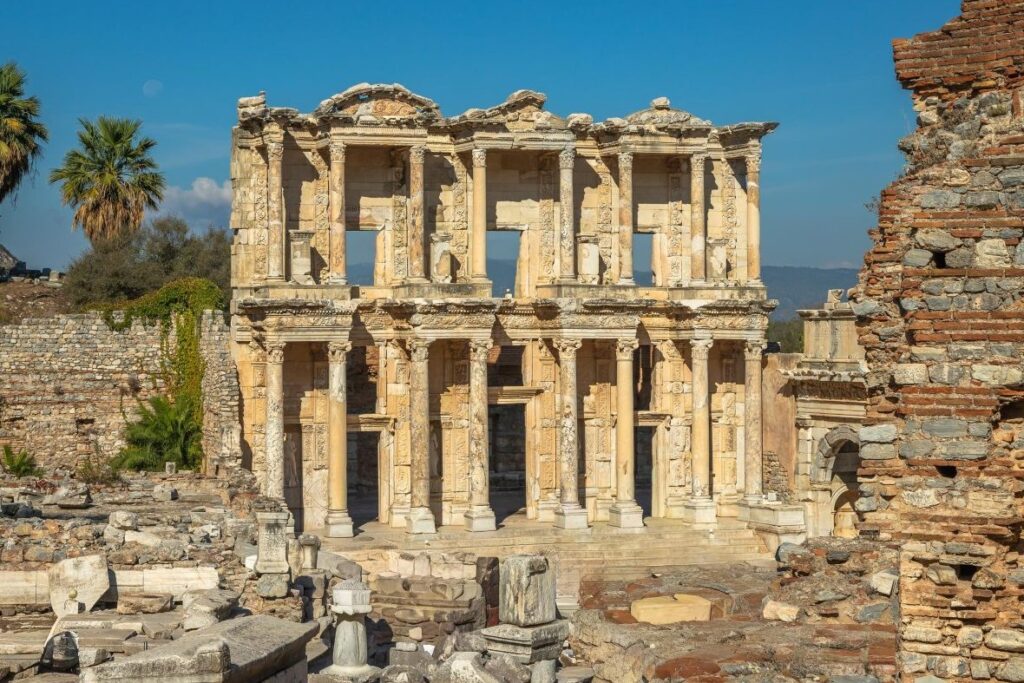
Ephesus is widely regarded as the most impressive and best-preserved ancient city in Turkey. Located near the Aegean coast, this magnificent metropolis was one of the largest and wealthiest cities of the Roman Empire and remains one of the most visited archaeological sites in the world.
The history of Ephesus stretches back to the Bronze Age, but the city rose to extraordinary prominence during the Hellenistic and Roman periods. Its strategic location on major trade routes and its proximity to a natural harbor allowed it to become a thriving commercial center linking Anatolia with the wider Mediterranean.
Ephesus was also one of the most important religious centers of antiquity. The city was home to the Temple of Artemis at Ephesus, one of the Seven Wonders of the Ancient World. Dedicated to Artemis, the goddess of fertility and the hunt, this colossal sanctuary attracted pilgrims from across the ancient world and helped establish Ephesus as a city of immense spiritual significance.
During the Roman era, Ephesus reached a population estimated at over 200,000 inhabitants. The city was adorned with marble-paved streets, monumental fountains, bath complexes, temples, and public buildings. Its most iconic structure, the Library of Celsus, was built in the 2nd century CE as a monumental tomb and library and remains one of the most recognizable façades in classical archaeology.
Other highlights include the Great Theatre, capable of seating around 25,000 spectators, the Curetes Street, the Terrace Houses with their exquisite mosaics and frescoes, and the Basilica of St. John nearby. Ephesus also occupies a central place in Christian history. Paul the Apostle preached here, and the city is mentioned prominently in the Book of Revelation as one of the Seven Churches of Asia.
Today, Ephesus is a UNESCO World Heritage Site and one of the crown jewels of Turkey’s archaeological heritage. Walking through its marble streets offers an unforgettable experience and a vivid sense of what urban life in the Roman world once looked like at its height.
Planning a visit? Don’t miss our complete guide to Best Things to Do in Ephesus.
5. Aphrodisias – The City of Marble and Sculpture
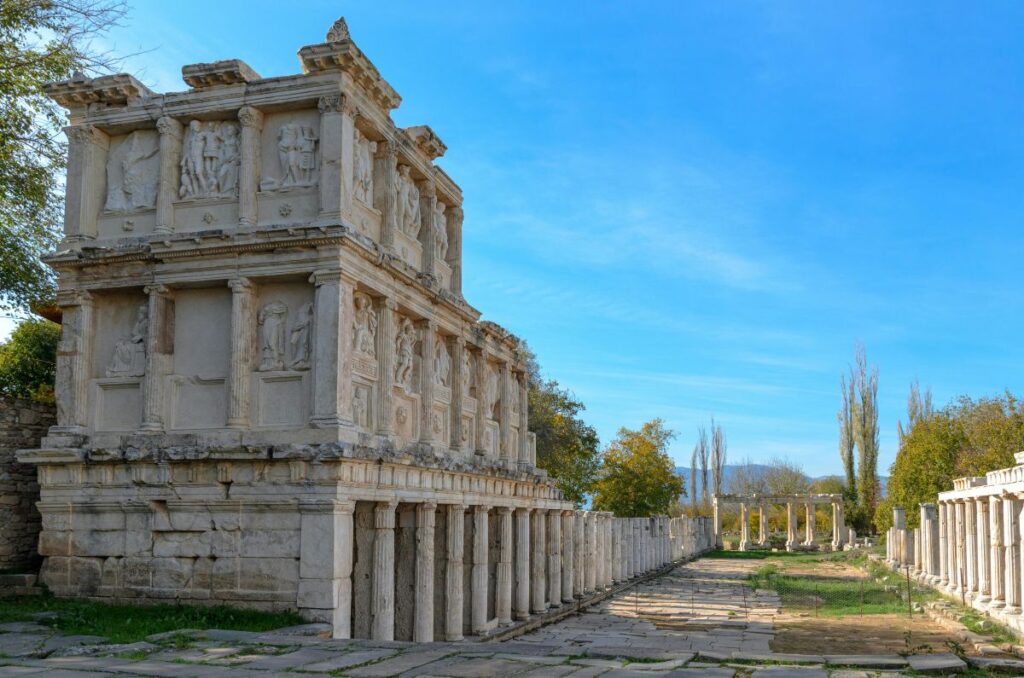
Aphrodisias is one of the most elegant and artistically significant ancient cities in Turkey. Dedicated to Aphrodite, the Greek goddess of love and beauty, this remarkable site flourished during the Hellenistic and Roman periods and became internationally renowned for its sculpture school and the extraordinary quality of its marble craftsmanship.
The city owed much of its prosperity to the rich marble quarries located in the surrounding hills. These quarries provided a nearly inexhaustible supply of high-quality stone, enabling local artisans to produce statues, reliefs, and architectural decorations that were exported throughout the Roman Empire. Sculptors trained in Aphrodisias were among the finest artists of antiquity, and many of their masterpieces are now displayed in the outstanding on-site museum.
Aphrodisias reached its peak between the 1st century BCE and the 6th century CE. During this period, the city was adorned with monumental buildings, broad avenues, and sophisticated public spaces that reflected both civic pride and artistic excellence. The Temple of Aphrodite formed the spiritual heart of the city and later served as the foundation for a Christian basilica, illustrating the transformation of religious life over time.
Among the most impressive structures are the monumental Tetrapylon, one of the most beautifully restored gateways in the ancient world; the Sebasteion, an extraordinary complex decorated with reliefs depicting emperors, gods, and mythological scenes; and a vast stadium that could accommodate around 30,000 spectators, making it one of the best-preserved stadiums from antiquity.
Because of its exceptional preservation and artistic importance, Aphrodisias was inscribed on the UNESCO World Heritage List in 2017. The site offers a uniquely refined archaeological experience, where visitors can appreciate not only grand architecture but also the remarkable creativity of the sculptors who transformed marble into some of the Roman world’s greatest works of art.
6. Sardis – Capital of the Lydian Kingdom and Home of the First Coins
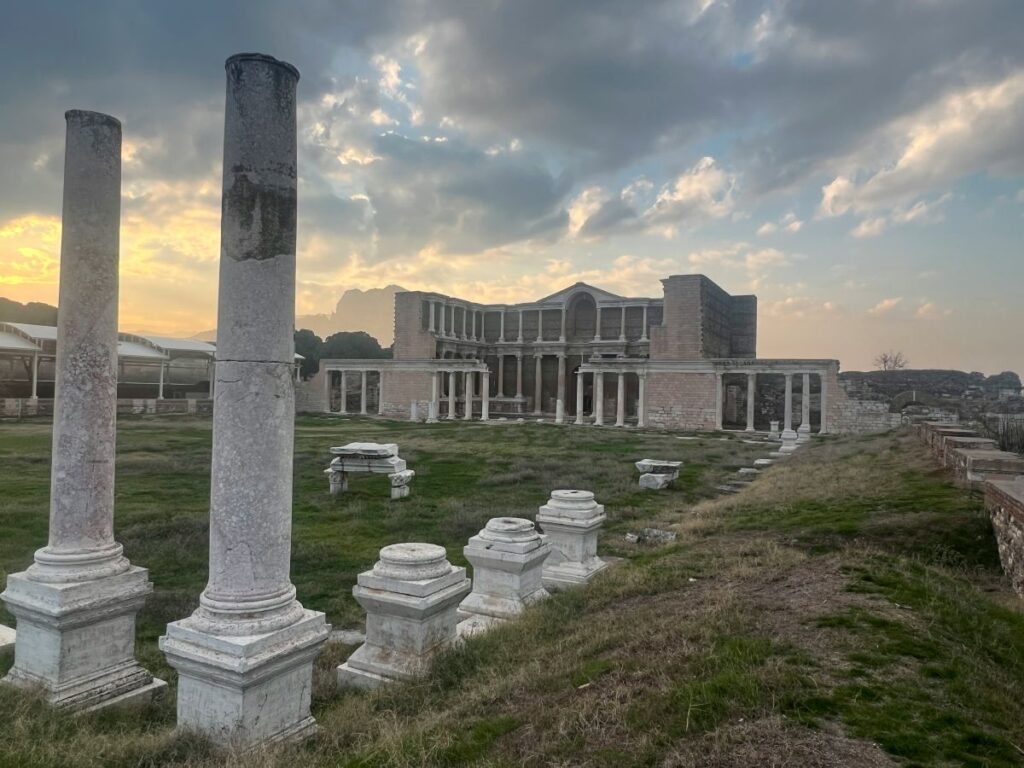
Sardis was the capital of the ancient Kingdom of Lydia and occupies a unique place in world history as the birthplace of coinage. Located at the foot of Mount Tmolus in western Anatolia, Sardis was one of the richest cities of the ancient world and played a decisive role in the development of commerce, banking, and urban civilization.
The city is most famously associated with Croesus, whose immense wealth gave rise to the enduring expression “rich as Croesus.” During the 6th century BCE, the Lydians introduced the first standardized coins made from electrum, a natural alloy of gold and silver. This innovation transformed trade by creating a reliable medium of exchange and laid the foundation for monetary systems that continue to shape the global economy today.
Sardis prospered because of its strategic location on major trade routes linking the Aegean coast with the interior of Anatolia and Mesopotamia. After the conquest of Lydia by the Persian king Cyrus the Great in 546 BCE, Sardis became the western terminus of the Royal Road, one of the most important communication networks of the ancient world.
The city remained prosperous under Hellenistic and Roman rule. Among its most remarkable surviving monuments are the monumental Gymnasium and Bath Complex, one of the largest Roman civic structures in Anatolia, and the impressive Sardis Synagogue, one of the largest and most significant ancient synagogues ever discovered. These remains reveal the city’s cosmopolitan population and the coexistence of diverse religious communities.
Sardis is also important in biblical history, as it was one of the Seven Churches of Asia mentioned in the Book of Revelation. Today, visitors can walk among soaring columns, mosaic floors, and the remains of a city that changed the history of money and commerce. Sardis stands as a powerful reminder that some of humanity’s most transformative innovations were born in the heart of ancient Anatolia.
7. Hierapolis – The Sacred City Above the White Travertines of Pamukkale
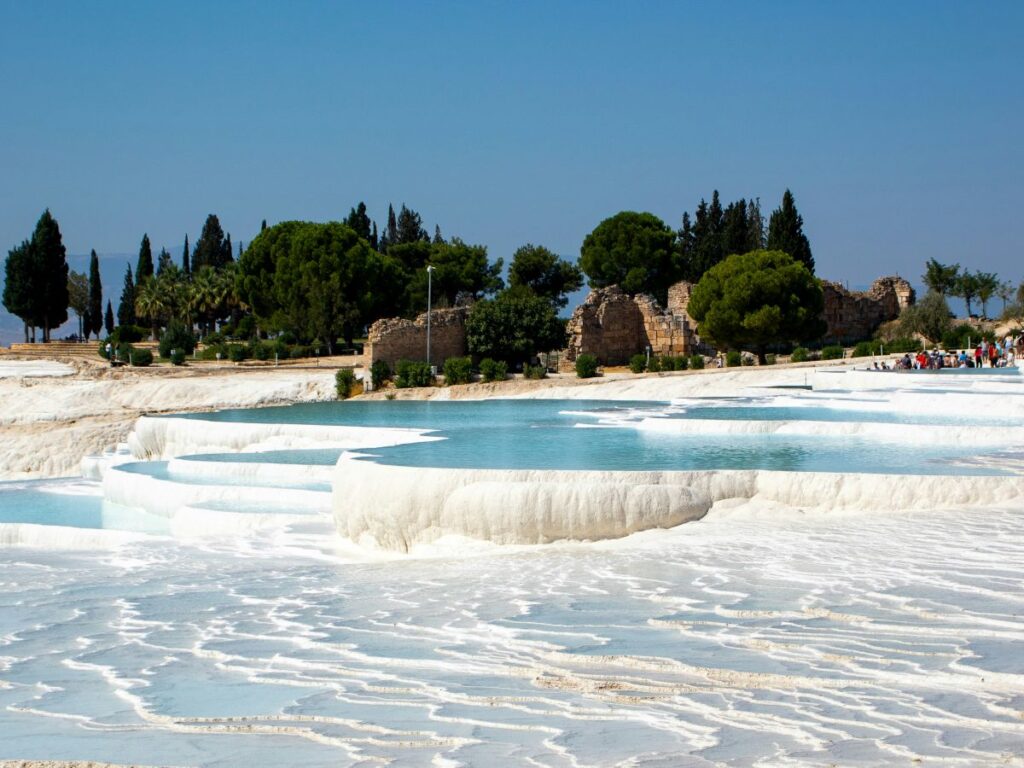
Hierapolis rises above the dazzling white travertine terraces of Pamukkale and ranks among the most extraordinary archaeological sites in Turkey. Combining natural beauty, religious significance, and impressive Roman ruins, Hierapolis offers one of the most memorable experiences in the ancient world.
The city was founded in the 2nd century BCE, most likely by the kings of Pergamon, and later flourished under Roman rule. Its name means “Sacred City,” reflecting the area’s long-standing religious importance. The thermal springs that created Pamukkale’s brilliant calcium terraces were believed to possess healing powers, attracting pilgrims and visitors seeking cures for a wide range of ailments.
During the Roman period, Hierapolis became a prosperous spa city and a major destination for health tourism. Wealthy visitors traveled from across Anatolia and the Mediterranean to bathe in the mineral-rich waters and to benefit from the city’s temples, baths, and sanctuaries. In many ways, Hierapolis was the ancient equivalent of a luxury wellness resort.
One of the site’s most intriguing features is the Ploutonion, a cave sanctuary dedicated to Pluto, god of the underworld. Ancient people believed that toxic gases emerging from the earth were evidence of a gateway to the realm of the dead. Priests performed rituals here, reinforcing Hierapolis’s reputation as a city where the natural and supernatural worlds intersected.
The city also contains one of the best-preserved Roman theaters in Turkey, a vast necropolis filled with sarcophagi and tombs, monumental gates, colonnaded streets, and the famous Antique Pool, where visitors can swim among fallen Roman columns. Hierapolis later became an important Christian center and is traditionally associated with the martyrdom of Philip the Apostle.
Today, Hierapolis and Pamukkale together form a UNESCO World Heritage Site. Few places in the world combine spectacular geology and monumental archaeology so harmoniously. Walking across the travertines and exploring the ancient city offers a vivid reminder of why this sacred landscape has captivated visitors for more than two thousand years.
Hierapolis is located within Pamukkale, and you can find practical travel tips in our guide to Best Things to Do in Pamukkale.
8. Termessos – The Mountain City That Defied Alexander the Great
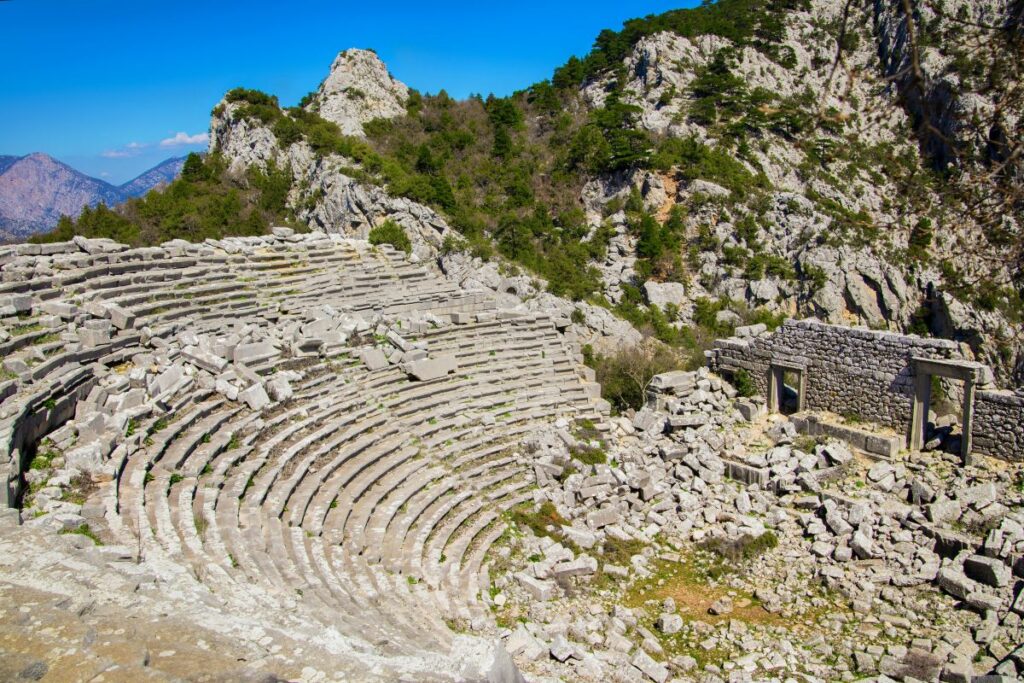
Termessos is one of the most dramatic and atmospheric ancient cities in Turkey. Hidden high in the rugged Taurus Mountains within Güllük Dağı National Park, this remarkable Pisidian city combines spectacular ruins with extraordinary natural scenery, creating an experience unlike any other archaeological site in the country.
Founded by the Solymi, an ancient people mentioned by Homer, Termessos occupied a formidable defensive position more than 1,000 meters above sea level. Its steep mountain setting made the city nearly impregnable and allowed it to maintain a significant degree of independence for centuries.
Termessos is especially famous for resisting Alexander the Great in 333 BCE. During his campaign through Anatolia, Alexander recognized the extraordinary strength of the city’s natural defenses and ultimately abandoned attempts to capture it. Ancient historians described Termessos as an eagle’s nest perched among the mountains, a description that remains strikingly accurate today.
The city flourished during the Hellenistic and Roman periods and contains an impressive range of monuments, including temples, agoras, gymnasia, cisterns, tombs, and one of the most beautiful theaters in Turkey. This theater, dramatically positioned on a mountain slope, offers breathtaking views across the surrounding peaks and valleys.
Unlike more heavily visited sites, Termessos retains a powerful sense of mystery. Pine forests, wildflowers, and rocky landscapes surround the ruins, and many structures appear to emerge organically from the mountainside. The combination of nature and archaeology creates a uniquely immersive experience, where visitors can imagine a fiercely independent community thriving in one of Anatolia’s most inaccessible settings.
Termessos is ideal for travelers who appreciate both history and hiking. It stands as a symbol of resilience, independence, and harmony with the natural world, and remains one of the most unforgettable archaeological destinations in Turkey.
9. Perge – The Grand Roman Metropolis of Pamphylia
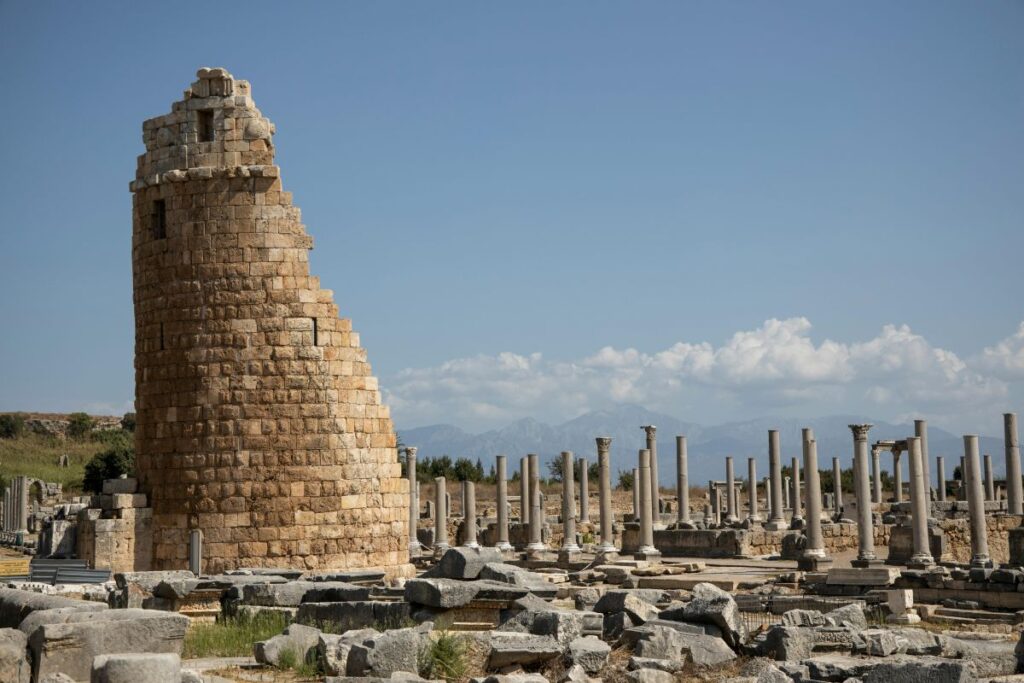
Perge was one of the most important cities of ancient Pamphylia and is today among the most impressive archaeological sites in southern Turkey. Located just inland from Antalya, Perge flourished under Hellenistic and Roman rule and became renowned for its monumental architecture, urban planning, and religious significance.
The city’s origins may date back to the Late Bronze Age, and ancient tradition linked its foundation to heroes returning from the Trojan War. Its strategic position near fertile plains and trade routes allowed Perge to develop into a prosperous commercial and cultural center.
Perge was especially associated with the worship of Artemis Pergaia, a powerful local goddess whose cult attracted pilgrims from across the region. The city later became an important stop in early Christian history. Paul the Apostle and Barnabas are believed to have passed through Perge during their missionary journeys, giving the city a prominent place in biblical travel traditions.
During the Roman imperial period, Perge reached its greatest prosperity. Visitors today can walk along an exceptionally well-preserved colonnaded avenue that once featured a water channel running through its center. The city also boasts monumental Hellenistic gates, bath complexes, a stadium, an agora, and one of the largest theaters in Anatolia.
Perge is particularly admired for the clarity of its urban layout. Streets, public buildings, and ceremonial spaces remain remarkably legible, allowing modern visitors to understand how a major Roman city functioned. Numerous statues and inscriptions discovered here reveal the civic pride and artistic sophistication of its inhabitants.
Together with nearby Aspendos and Side, Perge forms part of one of the richest archaeological regions in the Mediterranean. For history lovers exploring the Antalya area, Perge offers an essential and deeply rewarding journey into the grandeur of Roman Anatolia.
10. Mount Nemrut – The Monumental Sanctuary of the Commagene Kingdom
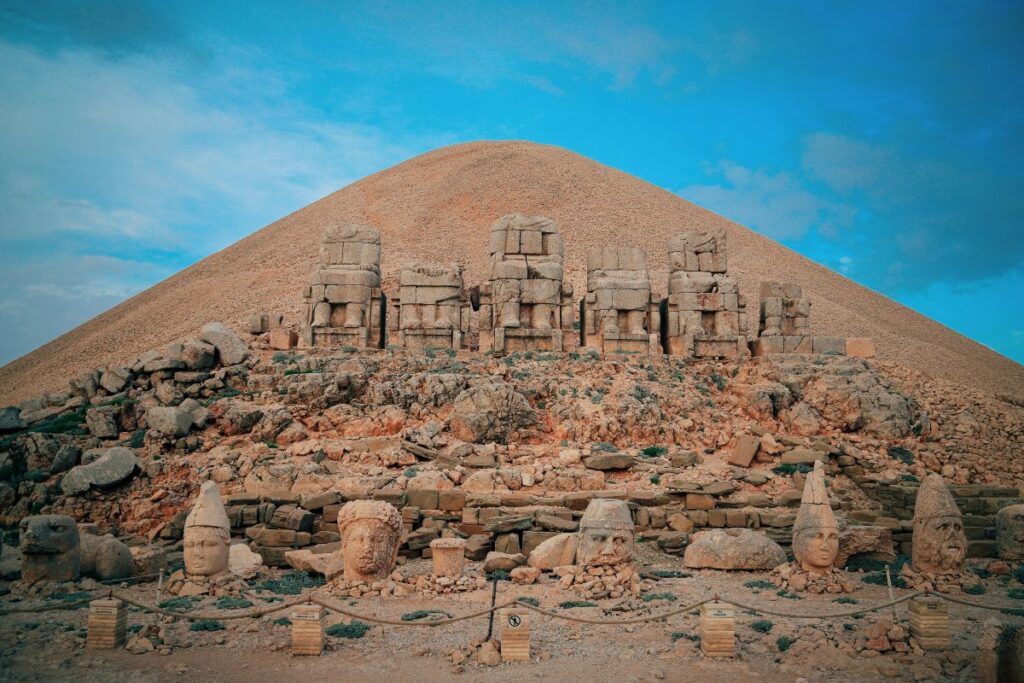
Mount Nemrut is one of the most extraordinary archaeological sites in the world. Rising to more than 2,100 meters above sea level in southeastern Turkey, this remote mountain summit is crowned by colossal stone statues and a monumental royal tomb that together create one of antiquity’s most mysterious and awe-inspiring landscapes.
The sanctuary was built in the 1st century BCE by Antiochus I Theos of Commagene, ruler of the small but culturally sophisticated Kingdom of Commagene. Situated between the great powers of Rome and Parthia, Commagene developed a unique identity that blended Persian, Greek, and Anatolian traditions.
Antiochus sought to immortalize both his dynasty and his divine ancestry. He constructed a vast tumulus of crushed limestone believed to conceal his burial chamber and flanked it with terraces lined by colossal seated statues representing a syncretic pantheon. These figures include Zeus-Oromasdes, Apollo-Mithras-Helios-Hermes, Hercules-Artagnes-Ares, the goddess Commagene, and the king himself.
Over time, earthquakes and weather caused the statues’ heads to topple from their bodies, creating the iconic scene that fascinates visitors today. The serene stone faces scattered across the summit rank among the most recognizable images in Turkish archaeology.
The sanctuary also contains reliefs depicting Antiochus shaking hands with the gods and an extraordinary lion horoscope that may represent one of the oldest known astrological monuments. These features reflect the king’s desire to unite religion, astronomy, dynastic propaganda, and political symbolism in a single monumental complex.
Recognized as a UNESCO World Heritage Site, Mount Nemrut offers one of the most unforgettable experiences in Turkey. Sunrise and sunset are particularly magical, when changing light casts dramatic shadows across the colossal heads and the surrounding mountains. Few places capture the ambition, spirituality, and artistic imagination of the ancient world as powerfully as Mount Nemrut.
For a broader journey through southeastern Anatolia, see our 10 Day Eastern Turkey Itinerary.
11. Sagalassos – The City in the Clouds
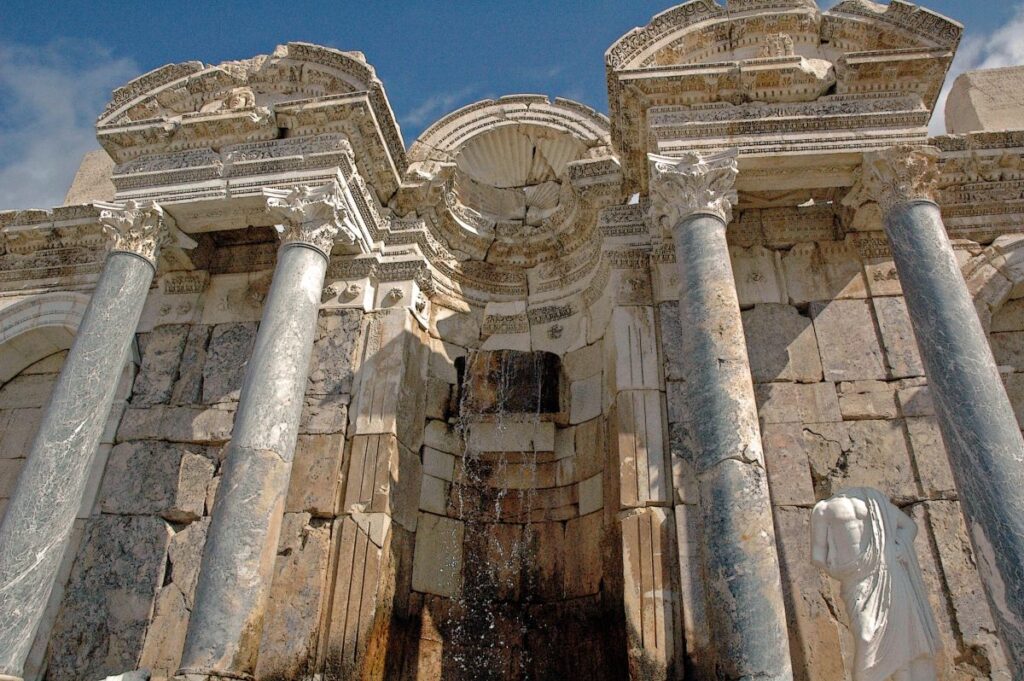
Sagalassos is one of the most spectacular and best-preserved mountain cities of the ancient world. Perched high on the slopes of the Taurus Mountains, this remarkable Pisidian city combines monumental Roman architecture with breathtaking alpine scenery, creating an archaeological experience that feels both majestic and intimate.
The site was inhabited for thousands of years, but Sagalassos flourished particularly during the Hellenistic and Roman periods. After being incorporated into the Roman Empire, the city prospered and became one of the leading urban centers of Pisidia. Its wealth is evident in the quality of its public buildings, finely carved stonework, and sophisticated engineering.
Sagalassos is famous for its monumental fountains, especially the restored Antonine Nymphaeum, where water still cascades across elaborately decorated marble façades just as it did nearly two thousand years ago. The city also contains an impressive theater, agoras, bath complexes, temples, and one of the highest altitude urban settlements in the Roman world.
Archaeological research led by Belgian teams has transformed Sagalassos into a model for modern scientific excavation. Studies of ceramics, pollen, climate, and human remains have provided exceptional insight into how ancient communities adapted to environmental change and shifting political conditions.
The city gradually declined after earthquakes, epidemics, and changing trade routes during Late Antiquity and the early Byzantine period. Eventually abandoned, Sagalassos remained hidden among the mountains for centuries, helping preserve its monuments in remarkable condition.
Today, visitors are rewarded with a unique combination of archaeological grandeur and natural beauty. The silence of the mountains, the flowing fountains, and the superb preservation of the ruins make Sagalassos one of Turkey’s most memorable archaeological destinations and a true hidden treasure for history enthusiasts.
12. Assos – Philosophy, History, and the Aegean Sea
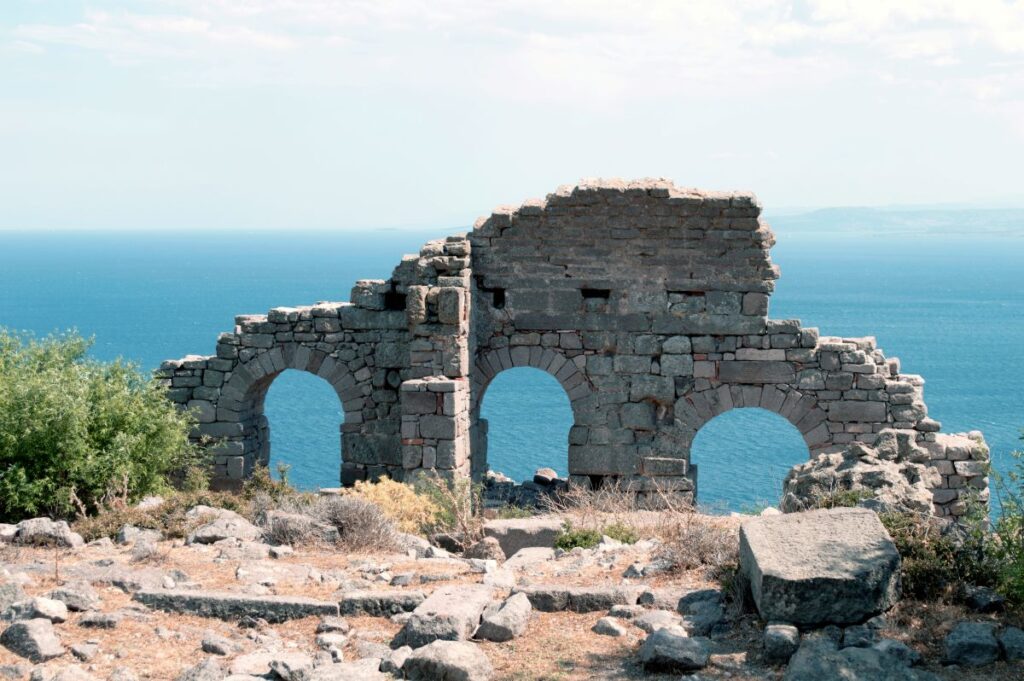
Assos occupies one of the most beautiful settings of any ancient city in Turkey. Perched on a volcanic hill overlooking the deep blue waters of the Aegean Sea and the island of Lesbos, Assos combines dramatic scenery, rich intellectual history, and remarkably preserved ruins.
Founded by Aeolian Greeks in the early first millennium BCE, Assos became an important center of trade and culture in northwestern Anatolia. The city is especially famous for its connection to Aristotle, who lived and taught here in the 4th century BCE after leaving Plato’s Academy in Athens. During his time in Assos, Aristotle conducted philosophical research and established a school that contributed to the development of Western thought.
The most iconic monument at Assos is the Temple of Athena, situated at the highest point of the acropolis. Dating to the 6th century BCE, it is one of the earliest Doric temples in Anatolia. The temple offers extraordinary panoramic views across the Aegean and remains one of the most photogenic archaeological sites in Turkey.
Below the acropolis lie the remains of the agora, bouleuterion, gymnasium, city walls, and a well-preserved theater facing the sea. These structures illustrate the urban organization of a prosperous Greek and Roman city.
Assos also played a role in early Christian history. Paul the Apostle is mentioned in the Acts of the Apostles as having traveled through the city during one of his missionary journeys.
Today, Assos offers a rare blend of archaeology, philosophy, and natural beauty. Few places allow visitors to contemplate the legacy of Aristotle while watching the sun set over the Aegean from the ruins of an ancient temple.
13. Aspendos – Home of the Best-Preserved Roman Theatre in the World
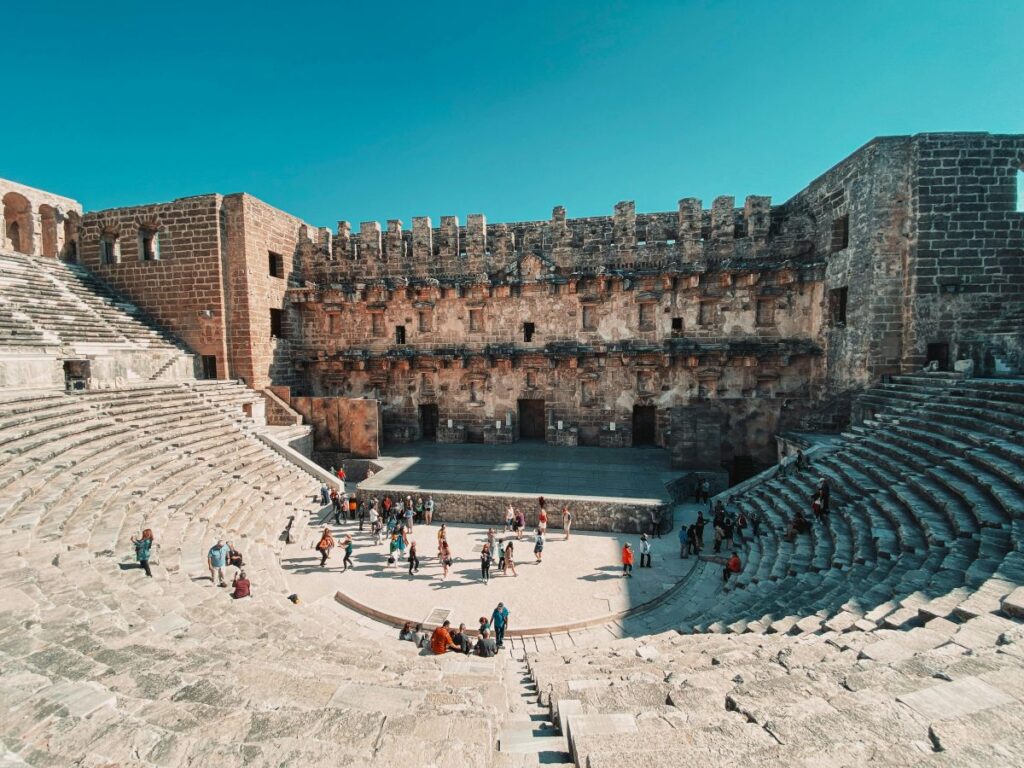
Aspendos is internationally famous for its magnificent Roman theater, widely regarded as one of the best-preserved ancient theaters anywhere in the world. Located east of Antalya in the fertile Pamphylian plain, Aspendos was one of the wealthiest and most influential cities of southern Anatolia.
The city was founded by Greek settlers, though archaeological evidence suggests the region had been inhabited long before the classical era. Its prosperity was fueled by agriculture, trade, and control of routes connecting the Mediterranean coast with the interior of Anatolia.
Aspendos reached the height of its importance during the Roman period. Its most celebrated monument, the theater, was constructed in the 2nd century CE during the reign of Marcus Aurelius and designed by the architect Zenon, a local citizen. With a capacity of approximately 15,000 spectators, the theater is renowned for its extraordinary acoustics, imposing stage building, and exceptional state of preservation.
Unlike many ancient theaters whose stage façades were destroyed over time, the theater at Aspendos retains much of its original superstructure. Later use during the Seljuk period contributed to its survival, demonstrating the continuity of architectural appreciation across different civilizations.
Beyond the theater, Aspendos also contains the remains of an agora, basilica, stadium, and aqueduct system. The nearby Roman aqueducts are engineering masterpieces, carrying water across the landscape with impressive precision.
Today, Aspendos remains one of Turkey’s most iconic archaeological attractions. Standing within its vast auditorium and speaking softly toward the stage is enough to understand why this monument continues to astonish visitors nearly two thousand years after its construction.
14. Xanthos – Capital of the Lycian Civilization
Xanthos was the principal city of ancient Lycia and stands as one of the most important archaeological sites in southwestern Turkey. As the political and cultural capital of the Lycian League, Xanthos preserves the distinctive traditions of one of Anatolia’s most fascinating indigenous civilizations.
The city is renowned for the fierce independence of its inhabitants. Ancient historians recorded that the people of Xanthos chose collective resistance rather than surrender when confronted by invading armies, most famously during the Persian conquest in the 6th century BCE. This spirit of autonomy became a defining feature of Lycian identity.
Xanthos flourished under Persian, Hellenistic, and Roman rule while maintaining many local cultural traditions. The site is especially celebrated for its funerary monuments, including pillar tombs, sarcophagi, and richly decorated reliefs that combine Anatolian, Persian, and Greek artistic influences.
Among the most famous discoveries from Xanthos are the inscriptions in the Lycian language, which played a crucial role in deciphering this ancient tongue. The site has provided invaluable evidence for understanding Lycian political organization, religion, and social life.
Together with nearby Letoon, the principal religious sanctuary of Lycia, Xanthos was inscribed on the UNESCO World Heritage List. Letoon was dedicated to Leto and her divine children Apollo and Artemis and served as the spiritual heart of the Lycian world.
Today, Xanthos offers visitors a profound encounter with a civilization that developed its own language, artistic style, and democratic traditions. Its monuments testify to the resilience and cultural sophistication of the Lycians and to the remarkable diversity of ancient Anatolia.
15. Olympos – Ancient Ruins Hidden in a Coastal Paradise
Olympos is one of the most atmospheric ancient cities in Turkey, where history and nature blend in extraordinary harmony. Nestled in a lush river valley that opens onto one of the most beautiful beaches on the Mediterranean coast, Olympos offers a uniquely romantic archaeological experience.
Founded as an important city of the Lycian civilization, Olympos later prospered under Hellenistic and Roman rule. Thanks to its sheltered harbor and strategic coastal position, the city became a significant maritime center. In certain periods, however, its remote location also attracted pirates, including the notorious Zenicetes, who used parts of the Lycian coast as strongholds.
The ruins are scattered through dense vegetation along both sides of a stream. Visitors encounter Roman bridges, city walls, sarcophagi, baths, churches, and harbor structures partially concealed by fig trees, oleanders, and pine forests. This integration of architecture and landscape gives Olympos an almost dreamlike atmosphere.
During the Byzantine period, Olympos remained an active settlement and an important bishopric. Several early Christian churches testify to the continuing significance of the city long after the classical era.
One of the highlights of the region is nearby Chimaera (Yanartaş), where natural flames emerge continuously from fissures in the rock. These eternal fires inspired ancient myths about the monstrous Chimera and have fascinated travelers for thousands of years.
Today, Olympos is beloved by travelers seeking both archaeology and natural beauty. Few places in Turkey allow visitors to explore ancient ruins in the morning, swim in crystal-clear waters in the afternoon, and watch eternal flames burn on a mountainside after sunset. It is a fitting conclusion to any journey through the ancient cities of Turkey.
Final Thoughts: Why Turkey Is a Paradise for Archaeology Lovers
From the Bronze Age capital of Hattusa to the coastal ruins of Olympos, Turkey offers one of the richest archaeological landscapes on Earth. These fifteen destinations represent only a small portion of the hundreds of ancient cities scattered across Anatolia, yet together they reveal the extraordinary diversity of civilizations that shaped this land.
The Hittites forged one of the great empires of the Bronze Age. The Lydians introduced the first coins. The Greeks established thriving city-states and centers of philosophy. The Romans built theaters, libraries, baths, and monumental roads. Indigenous cultures such as the Lycians and Pisidians developed unique artistic and political traditions. In the mountains of Commagene, kings blended Persian and Greek beliefs into monumental sanctuaries unlike anything else in the world.
For travelers, exploring these sites is far more than a sightseeing experience. It is an opportunity to walk through thousands of years of human achievement and to understand why Anatolia has always stood at the crossroads of civilizations.
Whether you are fascinated by mythology, classical architecture, biblical history, or ancient engineering, Turkey offers unforgettable journeys into the past. Each stone, inscription, and monument tells a story that continues to shape our understanding of world history.
If you love archaeology, few destinations can rival the depth, beauty, and historical significance of Turkey.
If you would like to explore even older chapters of Anatolian history, be sure to read our guides to Gobeklitepe,
Karahantepe, and Biblical Sites in Turkey.