Introduction: A City at the Crossroads of Civilizations
Few archaeological sites in the Mediterranean world capture the grandeur of classical antiquity as vividly as Few ancient cities illustrate the grandeur, complexity, and cultural richness of the classical world as vividly as Ancient Ephesus. Located near the modern Turkish town of Selçuk along the Aegean coast, Ephesus was once one of the most influential urban centers of the Mediterranean world. Over many centuries, the city developed into a major hub of commerce, religion, philosophy, and political power.
At its peak during the Roman Imperial period, Ephesus had a population estimated between 200,000 and 250,000 inhabitants, making it one of the largest cities in the eastern Mediterranean. Its strategic location on the coast of Asia Minor allowed it to connect maritime trade routes from the Aegean Sea with inland commercial networks reaching deep into Anatolia and Mesopotamia.
The city’s long history reflects the broader cultural evolution of the region. Ephesus was successively influenced by Anatolian cultures, Greek colonists, Persian rulers, Hellenistic kingdoms, and Roman emperors. Each civilization left its mark on the city’s architecture, religion, and political institutions.
Today, the archaeological remains of Ephesus provide one of the most complete windows into urban life in antiquity. Monumental structures such as the Library of Celsus, the Great Theatre, and the ruins of the Temple of Artemis continue to attract scholars, historians, and travelers from around the world.
If you’re planning a visit, don’t miss our detailed guide to the best things to do in Ephesus, including the Library of Celsus, the Great Theatre, the Terrace Houses, and practical travel tips.
Early Settlement and Anatolian Roots
Although Ephesus is often associated with Greek culture, archaeological evidence suggests that the area was inhabited long before the arrival of Ionian settlers. Excavations indicate that settlements existed in the region as early as the Bronze Age, possibly linked to the wider cultural networks of Anatolia and the Near East.
Some scholars have proposed that the region may have been connected to the Arzawa kingdom, an Anatolian state mentioned in Hittite texts from the second millennium BCE. The Arzawa lands were located in western Anatolia and frequently interacted with both the Hittite Empire and the Mycenaean Greek world.
These early cultural contacts demonstrate that the Aegean coast of Anatolia was already part of a broader international landscape long before the emergence of the classical Greek city-states.
The Arrival of the Ionian Greeks
The historical city of Ephesus began to take shape during the Ionian Greek migrations around the 10th century BCE. Greek settlers from mainland Greece established a network of cities along the western coast of Anatolia, forming what later became known as the Ionian League.
According to Greek tradition, the city was founded by Androclus, the son of the Athenian king Codrus. Whether this legend reflects historical reality remains uncertain, but it illustrates the strong cultural connection between Ephesus and the Greek world.
Ephesus quickly became one of the most prosperous cities of the Ionian region. Its natural harbor allowed merchants to trade with distant lands, including:
• mainland Greece
• Cyprus
• Egypt
• Phoenicia
• Mesopotamia
This commercial prosperity helped the city grow into an important intellectual center as well.
One of the most famous figures associated with Ephesus was the philosopher Heraclitus, who lived around 535–475 BCE. Heraclitus developed a philosophical worldview based on the concept of constant change, famously declaring:
“No man ever steps in the same river twice.”
His ideas would later influence major philosophical traditions in both the Greek and Roman worlds.
If you’re planning a visit, check our guide on the best things to do in Ephesus.
The Temple of Artemis: A Wonder of the Ancient World
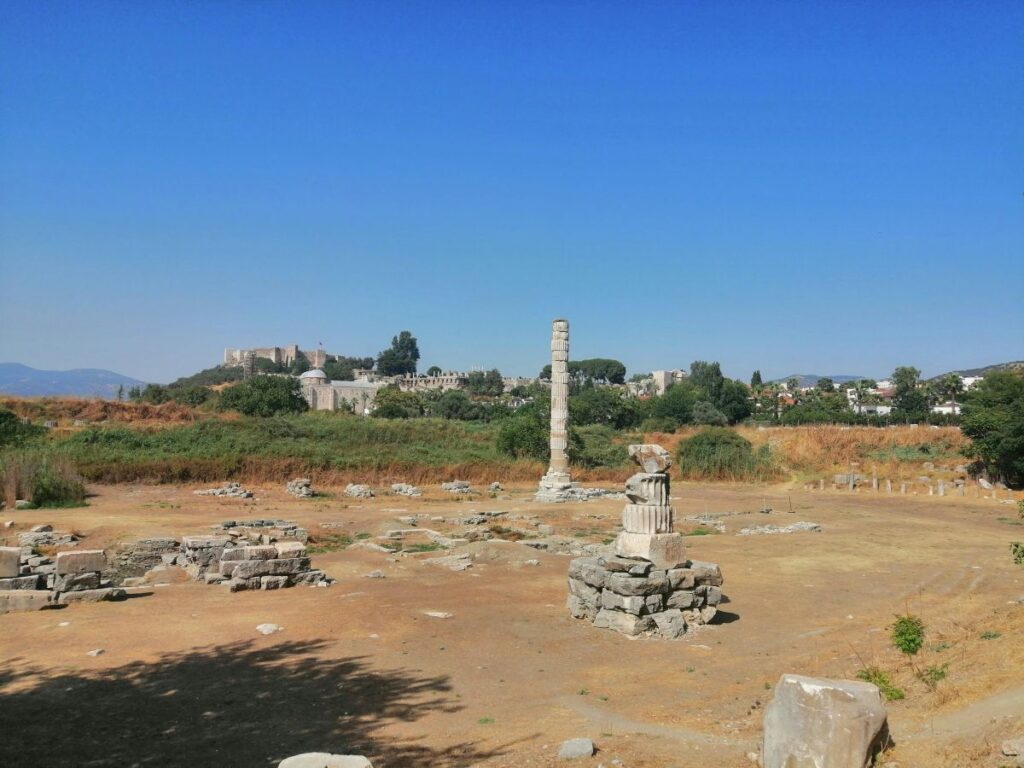
Perhaps the most famous monument of ancient Ephesus was the Temple of Artemis, one of the Seven Wonders of the Ancient World.
The temple was originally constructed around 550 BCE, under the patronage of the wealthy Lydian king Croesus. The sanctuary was dedicated to Artemis, the Greek goddess of hunting, fertility, and the natural world.
Unlike most Greek temples, the Ephesian Artemis had distinctive local characteristics, blending Greek religious traditions with older Anatolian fertility cults.
The temple was enormous by ancient standards. Ancient writers described it as measuring approximately 115 meters long and 55 meters wide, supported by more than 120 marble columns, each reaching a height of around 18 meters.
Pilgrims traveled from across the Mediterranean to visit the sanctuary, which also functioned as an important economic center. Merchants, artisans, and travelers gathered around the temple, transforming the area into a thriving commercial district.
The temple was destroyed and rebuilt multiple times. One of the most famous incidents occurred in 356 BCE, when a man named Herostratus burned the temple in order to achieve eternal fame. Ironically, his act ensured that his name would indeed be remembered throughout history.
Persian Rule and the Ionian Revolt
During the 6th century BCE, the Ionian cities of western Anatolia came under the control of the Achaemenid Persian Empire.
Persian rule integrated Ephesus into a vast imperial network that stretched from the Aegean Sea to the Indus Valley. While local Greek elites continued to govern their cities, ultimate authority rested with Persian satraps.
Tensions eventually erupted into rebellion during the Ionian Revolt (499–493 BCE), when several Greek cities attempted to overthrow Persian rule.
Although the revolt ultimately failed, it triggered a chain of events that led to the Greco-Persian Wars, including the famous battles of Marathon, Thermopylae, and Salamis.
These conflicts reshaped the political landscape of the eastern Mediterranean and cemented the rivalry between the Greek world and the Persian Empire.
Ephesus in the Hellenistic World
The arrival of Alexander the Great in Anatolia in 334 BCE marked the beginning of a new era for Ephesus.
Alexander’s conquest ended Persian control and ushered in the Hellenistic period, during which Greek culture spread widely across the Near East.
After Alexander’s death, Ephesus came under the control of several successor kingdoms, including the Seleucid Empire and later the Kingdom of Pergamon.
The city underwent significant urban redevelopment during this period. New public buildings, marketplaces, and theaters were constructed, reflecting the influence of Greek architectural traditions.
In 129 BCE, the last king of Pergamon bequeathed his kingdom to Rome, bringing Ephesus under Roman authority.
The Roman Golden Age of Ephesus
Under Roman rule, Ephesus flourished as the capital of the province of Asia.
The Romans invested heavily in infrastructure and monumental architecture. Among the most impressive structures built during this time were:
• the Library of Celsus
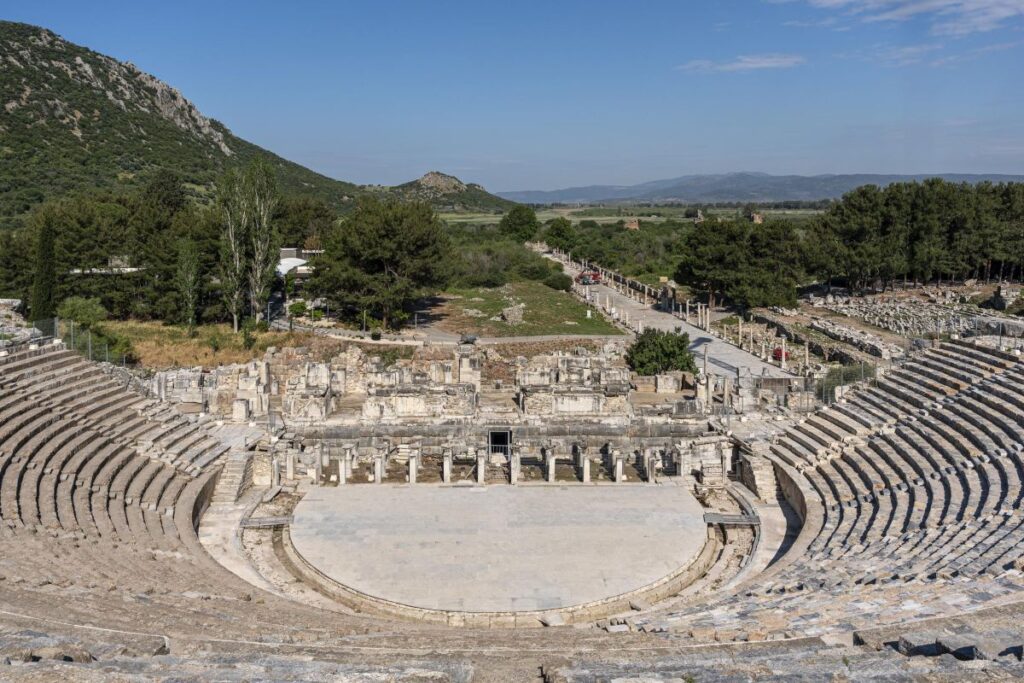
• the Great Theatre of Ephesus
• the Temple of Hadrian
• elaborate bath complexes
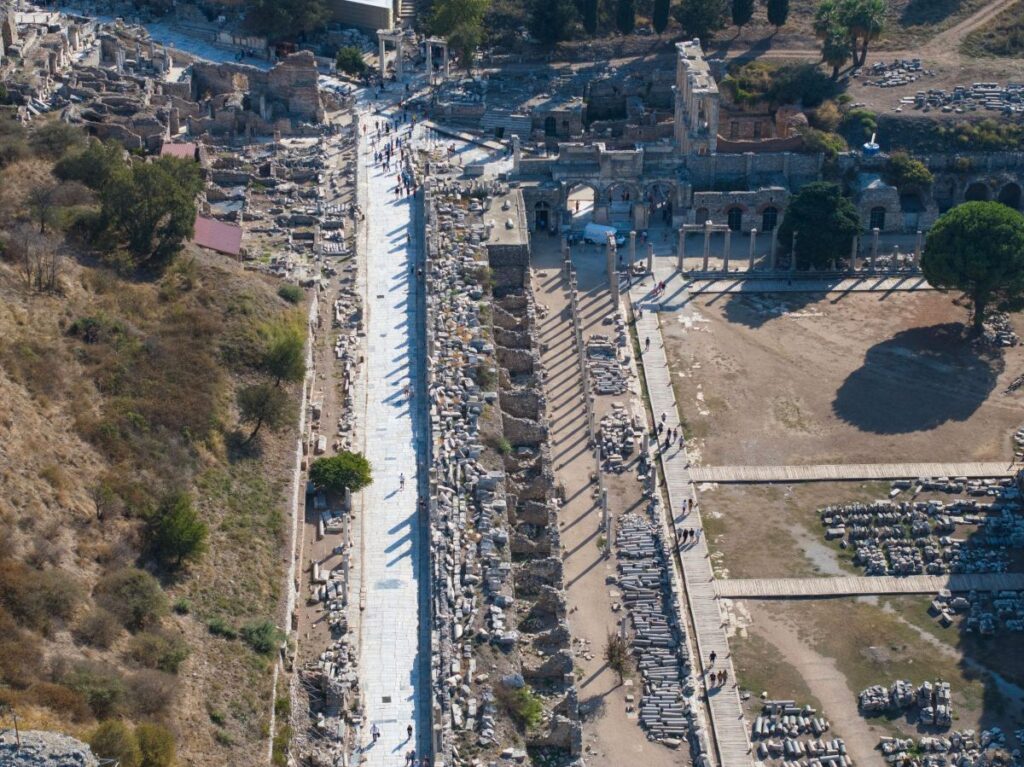
• marble-paved streets
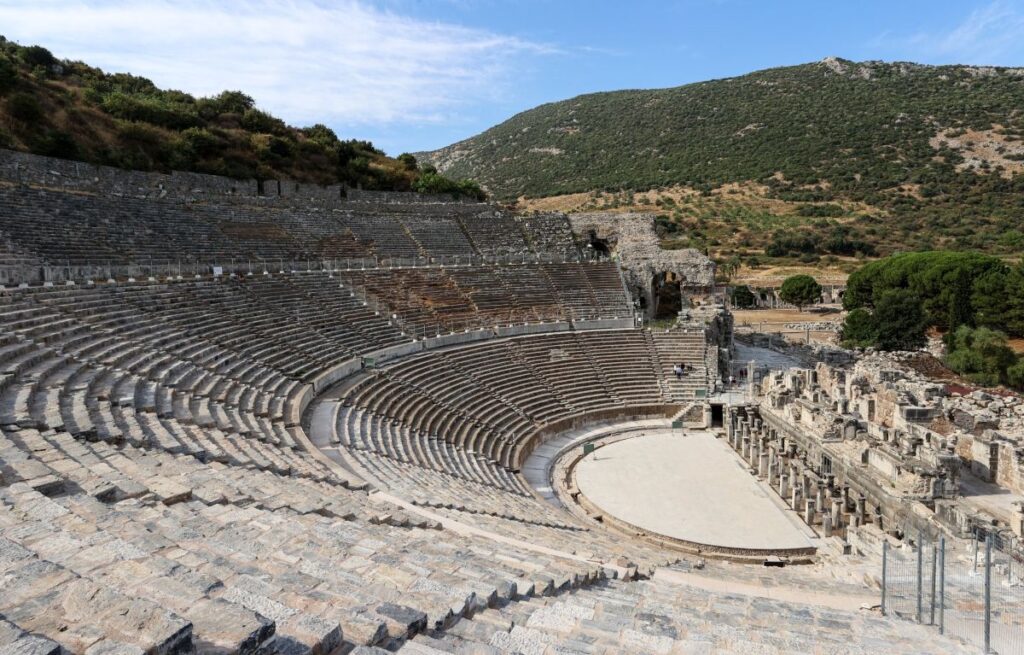
The Great Theatre, capable of seating 25,000 spectators, hosted theatrical performances, political gatherings, and public events.
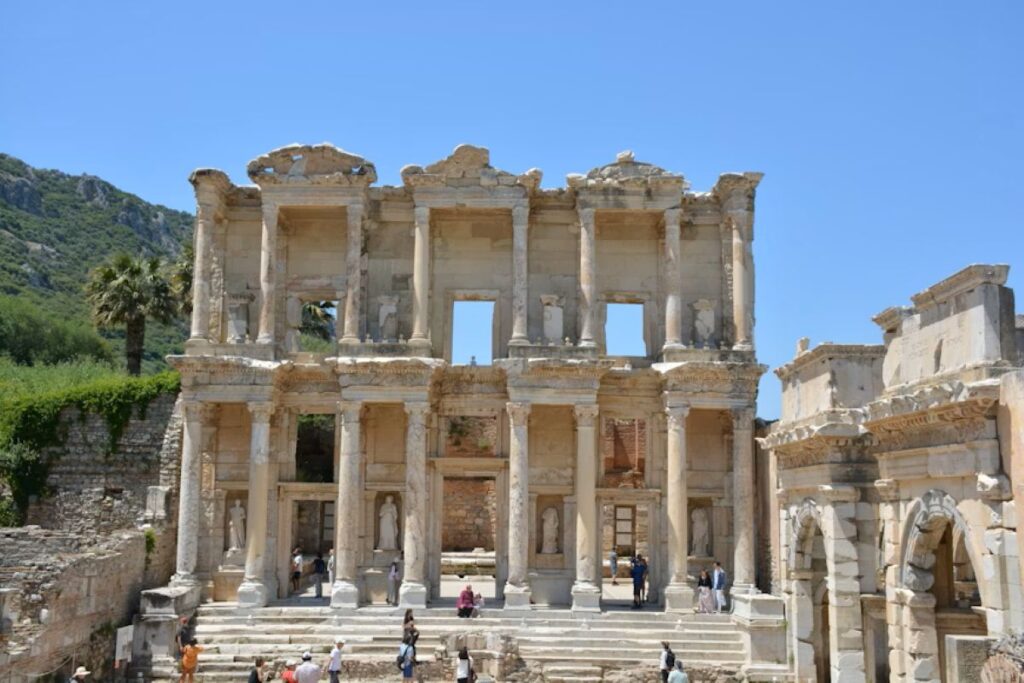
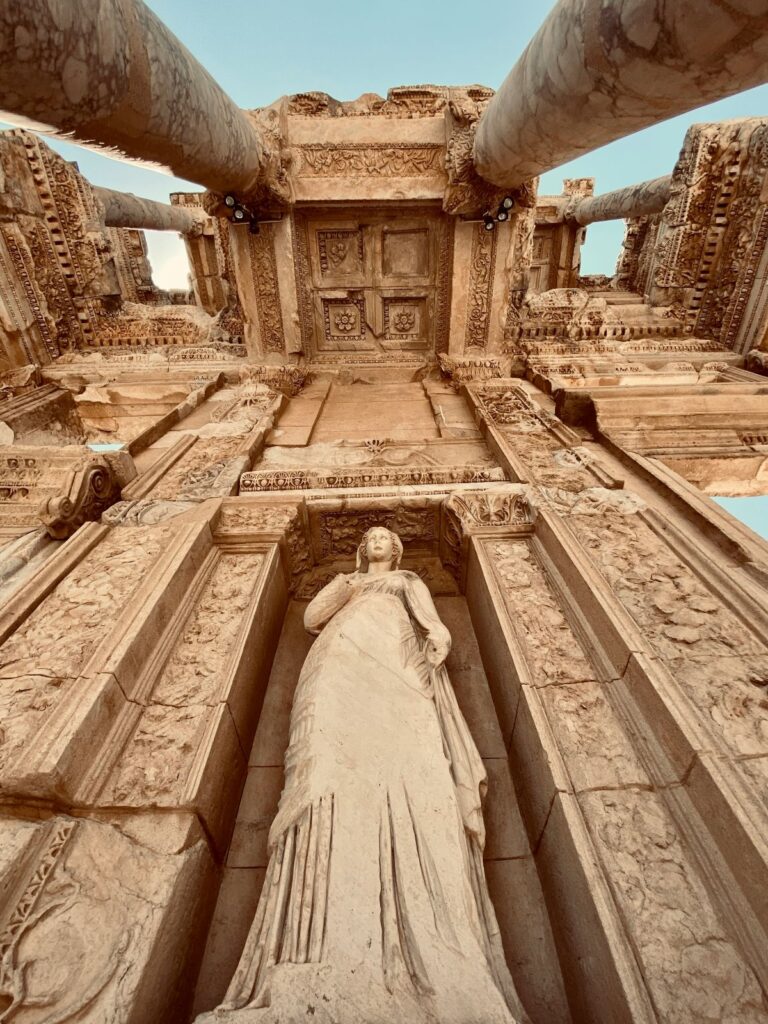
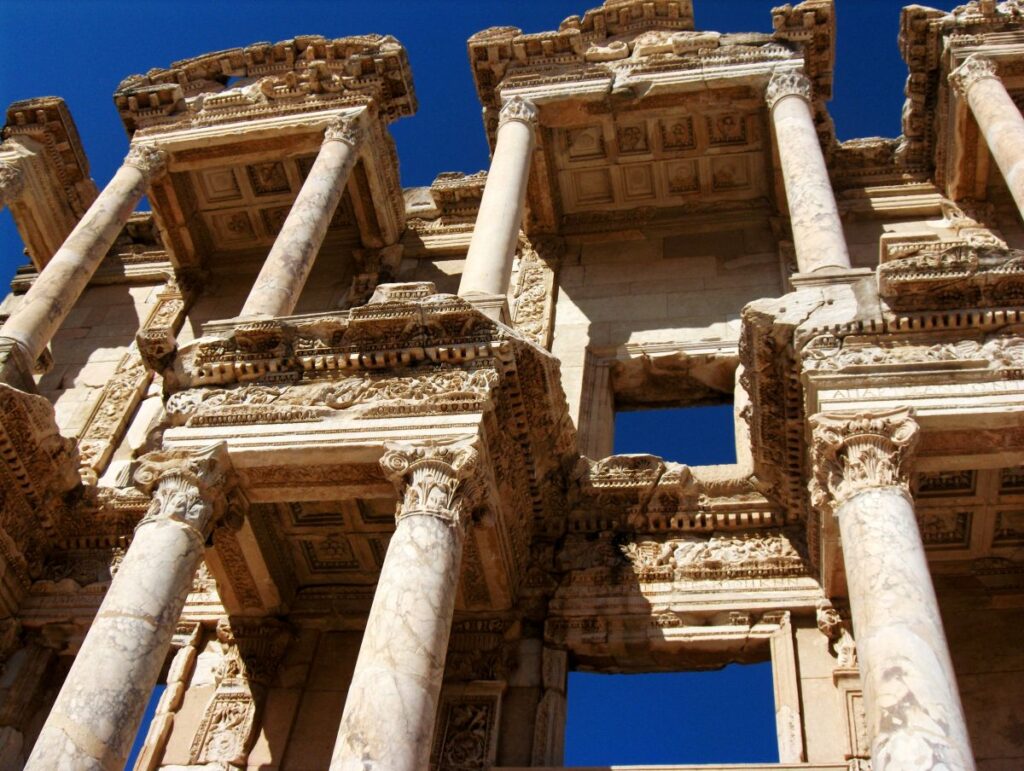
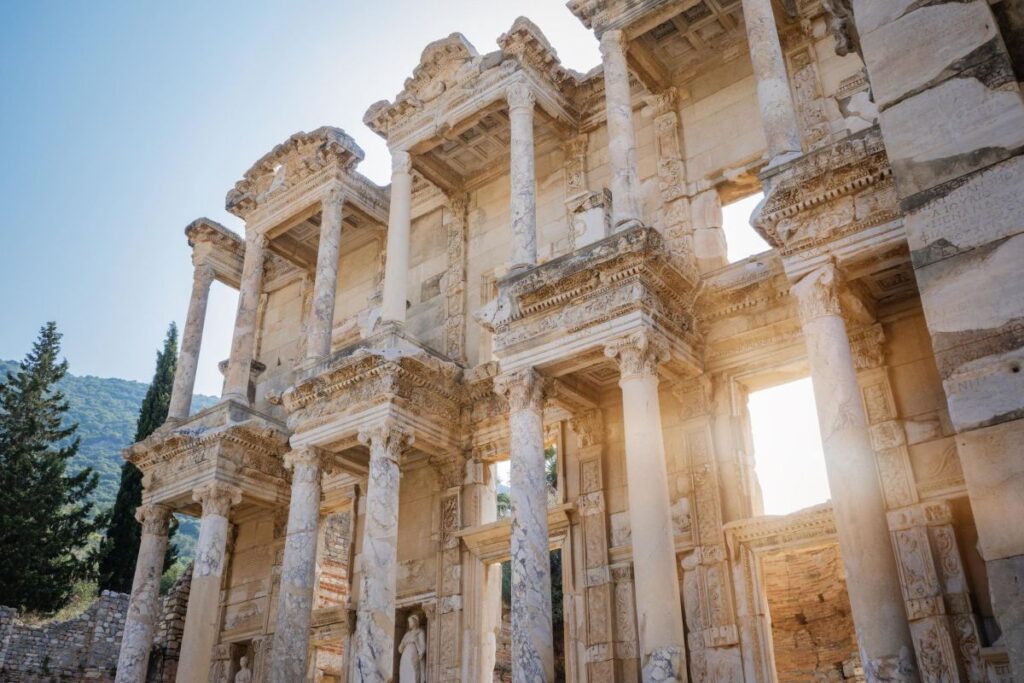
Meanwhile, the Library of Celsus, constructed in the 2nd century CE, served both as a library and as the monumental tomb of the Roman senator Tiberius Julius Celsus Polemaeanus.
Its beautifully restored facade remains one of the most iconic images of the ancient world.
What to See in Ancient Ephesus Today
For modern visitors, Ephesus is not only a historical subject but also one of the most impressive ancient cities to walk through in person. Many of its monuments are still visible along the ancient streets, allowing travelers to imagine the scale and daily life of the Roman city.
The most important highlights include:
- Library of Celsus
- Great Theatre of Ephesus
- Curetes Street
- Temple of Hadrian
- Terrace Houses
- Marble Road
- Agora
- Public latrines
- Ancient harbor street
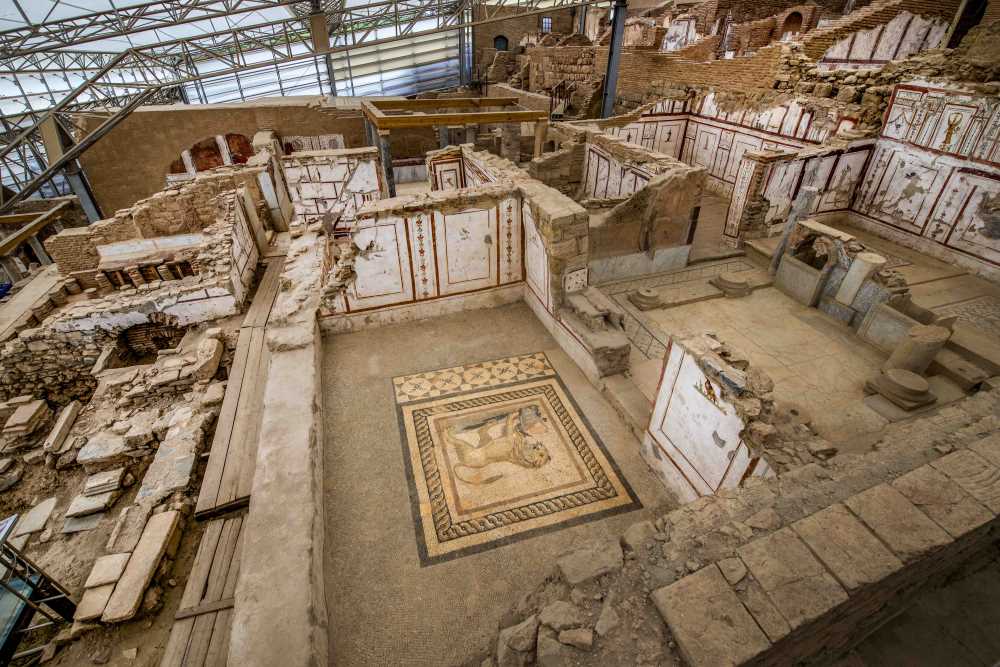
The Library of Celsus is the most photographed monument in Ephesus, but the Terrace Houses are often the most surprising part of the site. These houses belonged to wealthy Roman families and preserve mosaics, frescoes, and sophisticated urban design.
If you are visiting Ephesus for the first time, plan at least 2 to 3 hours for the main site. If you want to include the Terrace Houses and nearby attractions, half a day is more realistic.
Christianity and the Late Antique City
Ephesus also played an important role in the development of early Christianity.
The apostle Paul visited the city during the 1st century CE and preached to its inhabitants. According to the New Testament, Paul spent several years in Ephesus, helping to establish one of the earliest Christian communities.
The city later hosted the Council of Ephesus in 431 CE, a major event in the history of Christian theology.
Over time, however, the city began to decline. The harbor gradually filled with sediment from the nearby river, making maritime trade increasingly difficult.
Combined with earthquakes and shifting trade routes, this environmental change eventually led to the abandonment of the once-great city.
The Rediscovery of Ephesus
Modern archaeological excavations began in the 19th century, when European scholars sought to rediscover the lost cities of classical antiquity.
Systematic excavations conducted by the Austrian Archaeological Institute uncovered many of the city’s most famous monuments.
Today Ephesus is one of the most extensively excavated archaeological sites in the Mediterranean and a UNESCO World Heritage Site.
The ruins offer a remarkable glimpse into the urban life of the ancient world.
How to Visit Ephesus
Ancient Ephesus is located near Selcuk in western Turkey, close to the Aegean coast. The site is easy to reach from several popular travel destinations.
Common starting points:
- Selçuk: about 5–10 minutes
- Kuşadası: about 25 minutes
- İzmir: about 1 hour
- Pamukkale: often combined on longer Turkey itineraries
Many travelers visit Ephesus as a day trip from Kusadasi, especially cruise passengers. Others include it in a wider Turkey itinerary with Istanbul, Cappadocia, and Pamukkale.
The best time to visit is spring or autumn, when the weather is more comfortable. In summer, Ephesus can be very hot, especially around midday, because the archaeological site has limited shade.
Practical tips:
- Visit early in the morning if possible
- Wear comfortable walking shoes
- Bring water and sun protection
- Do not skip the Terrace Houses if you enjoy Roman history
- Consider a guided tour for deeper historical context
How Long Do You Need in Ephesus?
Most travelers need around 2 to 3 hours to explore the main archaeological site of Ephesus. This is enough time to walk through the ancient streets, see the Library of Celsus, visit the Great Theatre, and understand the basic layout of the city.
If you want a deeper visit, allow 4 to 5 hours. This gives you time to visit the Terrace Houses, take photos, read explanations, and explore the site without rushing.
A full Ephesus experience may also include nearby places such as:
- Temple of Artemis
- House of the Virgin Mary
- Basilica of St. John
- Ephesus Archaeological Museum
For history lovers, Ephesus can easily become a half-day or full-day cultural experience.
Conclusion
Ancient Ephesus stands as one of the greatest cities of antiquity. Its long history reflects the rise and fall of multiple civilizations, from Anatolian kingdoms and Greek colonists to Roman emperors and early Christian communities.
The city’s monumental architecture and cultural legacy continue to illuminate the complex history of the eastern Mediterranean.
Today, the ruins of Ephesus remain one of the most impressive archaeological sites in the world, preserving the memory of a city that once stood at the crossroads of civilizations.
You can also find information on Smithsonianmag