
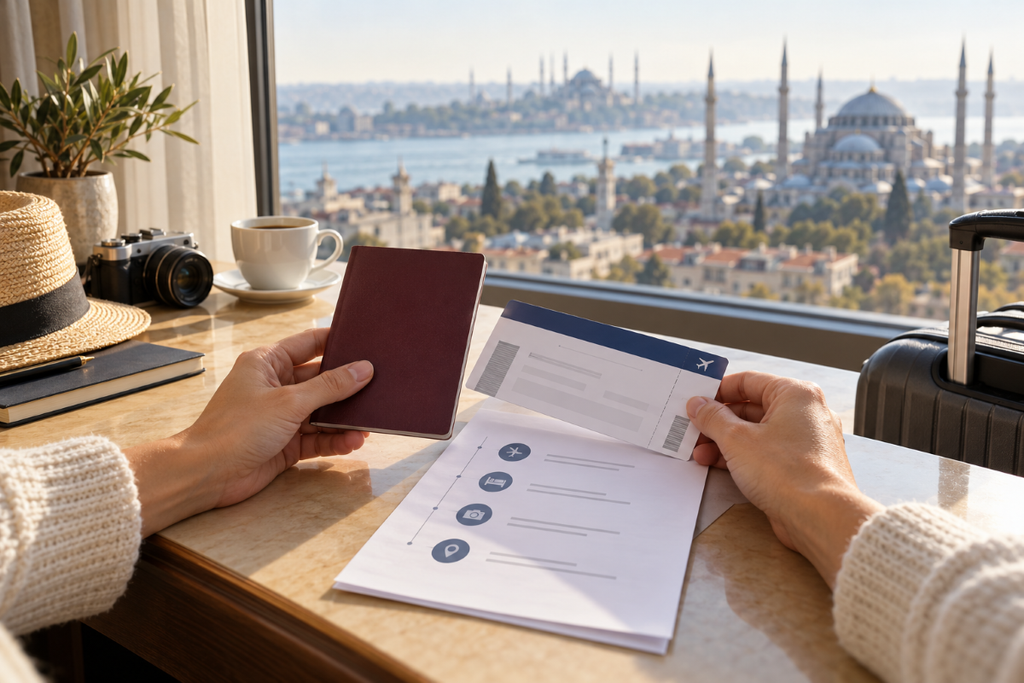
Turkey visa rules depend on the passport you will travel with, not only where you live or where your journey begins. Always check the current rule for your exact passport on Türkiye’s official Ministry of Foreign Affairs and e-Visa websites before booking or travelling.
Do You Need a Visa to Visit Türkiye?
There is no single visa rule for every visitor. Depending on your travel document and purpose, you may be able to:
- Enter visa-free for a limited stay.
- Apply online for an electronic visa (e-Visa).
- Apply for a visa through a Turkish embassy or consulate.
- Obtain a visa on arrival, but only if your nationality and circumstances qualify.
Some travelers need no visa, while others can apply online only if they meet extra conditions. A few need to arrange a consular visa before departure. The official Türkiye visa regime by nationality is the source to check first.
Use the passport you will actually present at check-in and at the Turkish border. A residence permit or visa from another country may be relevant to an e-Visa application for certain nationalities, but it does not automatically determine your Turkish visa status.
The Important Correction for U.S. Travelers
Ordinary U.S. passport holders travelling to Türkiye for a short visit are currently visa-exempt for up to 90 days in any 180-day period. They do not need to buy a visa at the airport or apply for a Turkish e-Visa for that visit.
This rule is for ordinary passports. Official passport holders may have different requirements. Check the Ministry’s current listing before travel, especially if your passport type or travel purpose is unusual.
Ordinary passport holders from several other common visitor markets, including the United Kingdom and Canada, are also currently listed as visa-exempt for up to 90 days in a 180-day period. Australia has a visa exemption for ordinary passport holders for touristic visits and transit for up to 90 days in any 180-day period. These examples are not a substitute for checking your own passport: rules can differ by passport class, nationality status and purpose of travel.
The Four Possible Visa Routes

1. Visa-free entry
If the Ministry lists your ordinary passport as visa-exempt for tourism, you do not need to apply for an e-Visa. Your stay is still limited. The permitted period may be stated as 90 days in any 180 days, or a different period for some nationalities.
Visa-free does not mean that every entry condition disappears. You still need an acceptable travel document, must respect the permitted stay and may be asked questions at the border. A visa exemption also does not allow you to work or study.
2. Türkiye e-Visa
The official Türkiye e-Visa portal is the only site to use for an online Turkish e-Visa application. An e-Visa is available only to eligible nationalities and is for tourism or trade/business visits. It is not the right visa for employment, study or other purposes that require a different visa category.
To check eligibility, select “Apply” on the official portal and enter the nationality and type of travel document you will use, together with your travel dates. The system displays the applicable conditions and fee for that profile. Depending on nationality, the portal may ask for an additional supporting document or other qualifying conditions.
For some passport holders, a valid visa or residence permit from a specified group of countries can be one of the conditions for an e-Visa. The precise list, validity rules and any airline or itinerary requirements must be checked against the live official result for that nationality. A visa issued electronically by another country is not necessarily accepted as a supporting document.
The e-Visa can be single-entry or multiple-entry, and the permitted stay differs by nationality. Do not assume that every e-Visa gives the same number of entries, validity period or length of stay.
3. Visa on arrival
A visa on arrival is not a general alternative for anyone who forgot to apply online. Türkiye’s official e-Visa FAQ maintains a limited list of nationalities that may qualify, and additional criteria can apply. The FAQ also makes clear that some nationalities eligible for an e-Visa are not eligible for a visa on arrival.
Check both the Ministry’s nationality listing and the official FAQs before relying on this option:
- Official e-Visa FAQ: Can I get a visa on arrival?
- Official e-Visa FAQ: Are all e-Visa-eligible nationalities eligible for visa on arrival?
The U.S. example is especially easy to misunderstand: ordinary U.S. passport holders are visa-exempt for a short tourist visit, rather than needing a visa on arrival. Never board a flight assuming you can solve an uncertain visa situation at the airport.
4. Sticker visa from a Turkish mission
If you are not visa-exempt and do not qualify for an e-Visa or visa on arrival, you may need to apply through a Turkish embassy or consulate. Türkiye’s visa pre-application system explains the application route and directs applicants who qualify for an e-Visa to the online portal.
The Ministry recommends applying at least one month before the planned trip to allow time for processing. Appointment availability and processing times can vary by country, season and application type, so check the Turkish mission responsible for your place of residence well ahead of travel.
Tourist visas are only one category. Work, study, family, medical and other purposes can require a different application and supporting documents. Do not use a tourist e-Visa to work or study.
The Ministry’s general visa guidance also says visa applicants must have medical insurance valid for their stay. Check the current checklist from the Turkish mission handling your application, because supporting documents can differ by visa type and location.
Examples of How Much Requirements Can Differ
The examples below show why “I heard you can get a Turkish visa online” is not enough to plan a trip:
| Passport example | Current route for an ordinary passport | What to remember |
|---|---|---|
| United States | Visa-exempt for up to 90 days in any 180-day period | No tourist e-Visa or airport visa is normally needed; official passport holders have different rules. |
| United Kingdom | Ordinary passport holders travelling for tourism are visa-exempt for up to 90 days in any 180-day period | Certain British nationality statuses, including BNO, British Subject and British Protected Person, are treated differently. |
| Canada | Visa-exempt for up to 90 days in any 180-day period | Official passport holders have different requirements. |
| Australia | Visa-exempt for touristic visits and transit for up to 90 days in any 180-day period | Official passport holders have different requirements. |
| People’s Republic of China | Ordinary passport holders are visa-exempt for up to 90 days in any 180-day period, effective 2 January 2026 | Check the Ministry listing again before travel because this is a recent change. |
| Egypt | The route depends on age and other conditions | The Ministry currently lists e-Visa options with extra conditions for some ordinary-passport holders aged 15–45; check the exact current criteria before applying. |
This is a small selection, not a complete country list. Passport categories, special nationalities and supporting-document rules can change the result. Use the live Ministry of Foreign Affairs country-by-country list for the final answer.
How Much Does a Turkish e-Visa Cost?
There is no single e-Visa price for all nationalities. The fee varies according to the country and type of travel document. The official application portal shows the current amount after you select your passport details.
For that reason, this guide does not publish a fixed fee table: it could become outdated and lead you to budget incorrectly. Check the amount directly on evisa.gov.tr before paying. Consular visa fees are a separate process; check the Turkish mission or visa pre-application system for the fee that applies to your application.
The official e-Visa portal states that its fee is paid in U.S. dollars, with the equivalent amount charged in the cardholder’s local currency. The portal accepts the listed card types and may require international online payments to be enabled. Follow the payment instructions shown during your own application.
Avoid unofficial visa websites
Search results may show private websites that offer to “help” with a Turkish e-Visa for an extra service charge. The official portal warns that such sites are not endorsed by or associated with the Turkish government. Use the address ending in evisa.gov.tr and check the spelling carefully before entering passport or payment information.
Passport Validity: Check the Date, Not Just the Visa
Türkiye’s general rule requires a passport or qualifying travel document to remain valid for at least 60 days beyond the duration of the visa, e-Visa, visa exemption or residence permit. For a visitor whose permitted stay is 90 days, the official example means at least 150 days of passport validity at the time of entry.
The Ministry also advises travelers to have a passport valid for at least six months from arrival. Because airlines and individual nationality rules can add practical complications, travelling with six months or more remaining is the safer approach whenever possible.
A small number of nationalities may be allowed to enter with a national identity card instead of a passport. This is a specific list, not a general rule for all European citizens. Check the Ministry’s current list of nationalities permitted to enter with an ID card before travelling without a passport.
How Long Can You Stay?
Many visa exemptions and visas allow a stay of up to 90 days within any 180-day period, but your own limit may be shorter. The visa’s validity period and the maximum number of days you may stay are not always the same thing.
For example, an e-Visa may be valid across a particular date range while allowing a shorter stay within that period. Read the final document carefully and follow the number of entries and maximum stay printed on it.
Türkiye’s 90-days-in-180-days rule applies across visits. You cannot reset the clock by leaving briefly and returning, or by switching to a second passport. If you need to stay longer than your visa or exemption permits, investigate the appropriate residence-permit route before your authorized stay ends.
Applying for an e-Visa: A Safe Checklist
- Confirm the exact nationality and type of passport you will use.
- Check the Ministry’s visa regime for foreigners.
- If the Ministry directs you to an e-Visa, use the official e-Visa application portal.
- Read any supporting-document, airline, entry-date or other conditions displayed for your profile.
- Enter your name, passport number and dates exactly as shown on your travel document.
- Check the number of entries, validity dates and maximum permitted stay before paying.
- Apply at least 48 hours before departure, as the official portal advises. Applying earlier is sensible in case you need to correct a mistake or resolve a payment issue.
- Save the issued e-Visa digitally and keep an accessible copy with your travel documents.
Each traveler needs their own e-Visa when one is required, including children and infants. The e-Visa portal supports family and group applications, but an application for a family does not mean one visa covers everyone. Verify every traveler’s document and application separately.
Does a Visa Guarantee Entry?
No. A visa or e-Visa permits you to travel to a port of entry and request admission; it does not create an absolute right to enter. Turkish border officials make the entry decision. Carry your travel documents and the information you need to explain the purpose and length of your visit.
Make sure the name and passport details on your visa match the document you present. If you receive a new passport after your visa is issued, or notice a spelling or number error, check the official portal or Turkish mission for the correct next step rather than assuming the document can be edited.
Special Cases: Transit, Cruises, Work and Study
- Airside transit: Visa rules can depend on whether you leave the international transit area, your passport and your itinerary. Check the official Ministry information if you will enter Türkiye during a connection.
- Cruise visits: The Ministry describes a limited permit for some cruise passengers visiting the vicinity of a port for up to 72 hours. This is a special port-area arrangement, not a general tourist visa or permission for an independent multi-day trip around Türkiye. See the Ministry’s official FAQ.
- Work or study: A tourist visa or tourist e-Visa is not a work or study authorization. Contact the relevant Turkish mission and follow the visa route for your actual purpose.
- Long stays: If you plan to remain beyond the period allowed by your visa or exemption, check residence-permit requirements with the Directorate General of Migration Management before travelling or before your permitted stay expires.
Before You Fly: Final Entry Checklist
- Check the rule for the exact passport you will present.
- Confirm whether you are visa-exempt, need an e-Visa, need a consular visa or qualify for visa on arrival.
- Check passport validity against both the official rule and your airline’s requirements.
- Confirm your permitted number of entries and maximum days of stay.
- Apply only through the official government portal or the correct Turkish mission.
- Keep the visa or e-Visa copy accessible, even if the system can verify it electronically.
- Recheck official information shortly before departure, especially if your trip is months away.
Visa rules and application fees change. The Ministry’s nationality table and the official e-Visa portal should be treated as the final authority for your trip.
Frequently Asked Questions
Do U.S. citizens need a visa for Türkiye?
Ordinary U.S. passport holders are currently visa-exempt for visits of up to 90 days in any 180-day period. They do not normally need a tourist e-Visa or a visa on arrival. Official passport holders and non-tourist purposes may follow different rules.
Can I get a Turkish visa at the airport?
Only certain nationalities may qualify for a visa on arrival, and extra conditions can apply. Being eligible for an e-Visa does not automatically mean you can get a visa at the airport. Check the official e-Visa FAQ and Ministry table before departure.
Is the Turkish e-Visa website free?
The application is not free for every nationality. The fee varies by passport and is shown by the official portal after you select your travel document. Some travelers are visa-exempt and do not need to apply or pay for an e-Visa at all.
Do children need their own Turkish e-Visa?
If a child’s nationality requires an e-Visa, the official portal says each traveler, including infants and children, must obtain a separate e-Visa. Check each child’s passport details and eligibility.
How long must my passport be valid?
The general statutory rule is at least 60 days beyond the permitted duration of your visa or visa-exempt stay. For a 90-day stay, that is 150 days from the entry date. The Ministry advises having six months of validity from arrival, which is the safer target.
Can I enter Türkiye with a European national ID card?
Some nationalities can, but the privilege applies only to countries listed by the Ministry. Do not assume that every European Union or Schengen-country citizen can enter without a passport.
Can I use a Turkish tourist e-Visa to work remotely or study?
A tourist e-Visa is for tourism or trade/business visits, not employment or study. If your purpose involves work, education or a longer stay, check the appropriate visa and residence requirements with a Turkish mission.